Here is a scenario that plays out in organisations more often than anyone likes to admit.
An employee is disciplined for violating a code of conduct. The employee pushes back and claims the policy they were given said something different. The HR team pulls up the current policy. Legal pulls up a version from a shared drive. The manager remembers being briefed on an update six months ago. Nobody can confirm which version was in effect at the time of the incident, which version the employee acknowledged, or whether the update was ever formally communicated.
That organisation now has a problem that has nothing to do with the original conduct issue.
This is a version control failure. And it creates legal exposure that is entirely preventable.
What Policy Version Control Actually Means
Version control is the practice of tracking every change made to a policy document, recording who made the change, when it was made, and why, and ensuring that only one authorised version is live at any given time.
Think of it like a paper trail for your policies. Not a trail of the policy itself, but a trail of everything that happened to the policy across its life: who drafted it, what changed between version 1.0 and version 1.3, who approved the final text, and which employees were required to acknowledge which version.
Without that trail, a policy is just a document. With it, a policy becomes defensible.
The difference between those two things is what this article is about.
The Legal Risks That Version Control Directly Addresses
The “Which Version Applied?” Problem
When a dispute arises, whether in an employment tribunal, a regulatory investigation, or a civil claim, one of the first questions asked is: what did your policy say at the time of the incident?
If you cannot answer that with documentary evidence, you cannot use the policy as part of your defence. A policy that exists today does not prove what your rules were twelve months ago. Regulators and courts want to see the specific version that was in force, when it took effect, and how it was communicated.
The average GDPR fine climbed to €2.7 million in 2024, and those investigations almost always involve questions about what policies existed, whether they were current, and whether they were followed. Organisations that cannot produce version-specific evidence are at a significant disadvantage.
The Outdated Policy Problem
Policies that are not version-controlled have a tendency to drift. Multiple copies exist across shared drives, email attachments, and local folders. Employees reference a version from two years ago without knowing a newer one exists. Managers brief their teams on requirements that the policy has since changed.
When an incident occurs, the organisation discovers that different parts of the business were operating under different versions of the same policy. Proving consistent, organisation-wide compliance becomes impossible.
What Happens When Version Control Breaks Down: A Real Pattern
The pattern shows up across industries. A financial services firm updates its conflicts of interest policy following regulatory guidance. The update is approved, but the old PDF remains accessible on the intranet. Some employees read the new version. Others continue referencing the old one. A year later, a regulatory audit finds inconsistent disclosures from different teams. The firm cannot demonstrate that all employees were working from the same policy at the same time. The audit result reflects that failure.
Or consider an HR example. A company revises its disciplinary procedure to bring it in line with updated employment law guidance. The revised version is emailed to managers. Six months later, a manager disciplines an employee following the old procedure because that is what they had saved. The resulting employment claim focuses heavily on whether the correct procedure was followed, and the company struggles to prove when the new version was issued, whether the manager received it, and whether they acknowledged it.
Neither of these situations requires malicious intent. They are the predictable result of treating policies as static documents rather than managed assets.
The Five Elements of Effective Policy Version Control
1. A Clear Numbering System
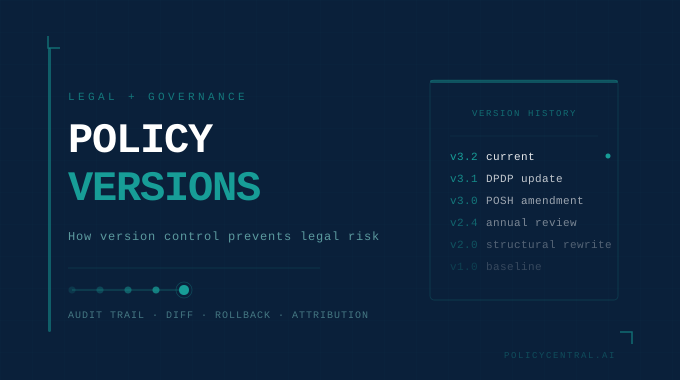
Every policy should carry a version number that updates every time a change is made. The convention most organisations use is major and minor versioning: version 1.0 for the initial release, version 1.1 for minor updates, version 2.0 for significant revisions that change the substance of the policy.
This sounds administrative. Its legal function is significant. When you can show that version 2.0 of your whistleblowing policy was published on a specific date, approved by named individuals, and superseded version 1.3, you have a documented history that is difficult to challenge.
2. A Change Log
Every new version of a policy should be accompanied by a brief record of what changed and why. This does not need to be lengthy. A two or three sentence summary noting which sections were updated and what triggered the update is sufficient.
The value of this becomes clear in audits and disputes. Being able to show that a policy was updated specifically because a regulation changed, and that the update was made promptly after that change, demonstrates active compliance management rather than accidental compliance.
3. Version-Specific Acknowledgements
This is the element that most organisations get wrong. Acknowledgements must be tied to a specific version, not to a policy title. An employee who acknowledged version 1.0 of the code of conduct has not acknowledged version 2.0. If the revised version contains materially different requirements, that distinction is not a technicality. It is legally significant.
Regulators want proof that policies are reasonably designed and actually understood by the people executing them, and that is not something a PDF template or once-a-year training can deliver. Version-specific acknowledgements are a core part of that proof.
4. A Single Source of Truth
An organisation should have one authorised home for its current policies. Every employee should be able to access this location. Every other copy, whether in email archives, shared folders, or local drives, should be understood as unofficial.
When multiple versions of a policy are circulating in different places, you cannot guarantee which version an employee is reading. And when you cannot guarantee that, you cannot guarantee consistent compliance.
Maintaining a single digital repository for policies ensures version-controlled access for all employees and eliminates the ambiguity that creates legal exposure.
5. Retention of Superseded Versions
Retiring a policy does not mean deleting it. When a policy is updated and a new version takes effect, the previous version must be preserved in an archive. It should no longer be accessible to employees as a current document, but it must be retrievable for audit and legal purposes.
The reason is straightforward. If an incident occurred while version 1.2 was in effect, and you are now on version 2.1, you need to be able to produce version 1.2 as evidence. An organisation that cannot produce historical versions of its policies is operating without a complete compliance record.
Version Control and Regulatory Audits
Auditors in regulated industries are not simply checking whether policies exist. They are checking whether policies were current, whether they were communicated, and whether there is evidence that employees understood and acknowledged them.
What actual, functional compliance looks like includes one clear owner per policy with defined editing permissions and visible audit trails, not shared ownership across legal, HR, and operations, but one specific named person.
Version control makes audit preparation faster and more reliable. When every policy has a version history, approval records, a distribution log, and version-specific acknowledgement records, an auditor’s questions become easy to answer. You can show exactly what was in place at any given time, who authorised it, and who confirmed they understood it.
Without version control, audit preparation becomes a reconstruction exercise. Teams scramble to piece together timelines from email threads and memory. Evidence is incomplete. The audit process itself reveals gaps in governance that would not have existed with proper version management.
Version Control During Policy Updates: The High-Risk Moment
The most legally vulnerable moment in any policy’s life is the update.
A policy update creates a gap: there are now employees who have acknowledged the old version and have not yet acknowledged the new one. During that window, the organisation is in a transitional state. If an incident occurs during this window, the question of which version applied and who had been informed of the change becomes central.
Managing this well requires a clear update workflow. When a policy is revised, the new version should be published with a defined acknowledgement deadline. Employees should receive a notification that explicitly states what changed, why it changed, and what the deadline is for acknowledging the new version. Acknowledgement should be tracked individually and in real time.
Automated reminders ensure that the acknowledgement gap closes within the defined window rather than remaining open indefinitely. The organisation’s compliance record then shows a clean transition from one version to the next, with no ambiguity about who acknowledged what and when.
The Connection Between Version Control and Employee Trust
There is a dimension to this that sits outside strict legal risk management.
When employees receive outdated policies, contradictory policies, or updated policies without clear explanation of what changed, trust in the organisation’s governance erodes. People follow rules more willingly when they believe those rules are managed seriously. A policy that arrives as a “please review the attached” email with no context signals that compliance is a formality, not a priority.
Version control, done well, communicates something different. It signals that the organisation treats its own policies with care. Clear version numbers, plain-language change summaries, and timely notifications show employees that the policy means something, that it was deliberately updated, and that their acknowledgement of it has genuine significance.
This cultural signal matters. Organisations with strong compliance cultures have fewer incidents, not only because employees know the rules, but because they believe the rules are worth following.
Key Takeaways
Policy version control is not a technical feature. It is a governance practice with direct legal consequences.
Without it, organisations cannot prove which policy was in effect at any given time. They cannot demonstrate that employees were aware of changes. They cannot defend themselves in audits or disputes with documentary evidence. And they cannot manage the transition between policy versions without leaving gaps in their compliance record.
With it, every policy update is traceable. Every acknowledgement is specific. Every audit question is answerable. And the risk that a version control failure turns a manageable compliance issue into a serious legal problem is substantially reduced.
The organisations that manage this well are not doing anything complicated. They are applying a consistent, systematic approach to something that most organisations handle casually. That discipline, more than any individual policy, is what makes compliance defensible.
Frequently Asked Questions
What is the difference between a major and minor policy version update?
A minor update, typically noted as an increase in the second number such as 1.1 to 1.2, covers small corrections, formatting changes, or clarifications that do not alter the substance of the policy. A major update, noted as an increase in the first number such as 1.x to 2.0, covers substantive changes that alter what is required of employees. Major updates typically require a new round of acknowledgements from all applicable employees.
Do employees need to re-acknowledge a policy every time it is updated?
For minor updates that do not change employee obligations, re-acknowledgement may not be necessary. For any update that changes what employees are required to do, re-acknowledgement is strongly recommended and, in regulated industries, often required. Your acknowledgement policy should define the threshold for re-acknowledgement and apply it consistently.
How long should superseded policy versions be retained?
Retention periods depend on the type of policy and the regulatory environment you operate in. A common baseline is seven years for employment-related policies, to cover potential employment claims, and longer for policies in regulated sectors such as financial services or healthcare. Consult with your legal team to define retention schedules for each policy category.
What is the best way to communicate a policy update to employees?
Lead with what changed and why. A brief plain-language summary of the key changes, delivered through the channels your employees actually use, is more effective than sending the full document and expecting employees to identify the differences themselves. State the acknowledgement deadline clearly in the first communication.
Can version control be managed manually?
For very small organisations, manual version control using a consistent naming convention and a centralised folder is workable. For organisations with a significant number of policies or employees, manual version control creates too many opportunities for error. Dedicated policy management software automates version tracking, acknowledgement assignment, and audit reporting, and significantly reduces the administrative burden on compliance teams.