If you work in compliance, HR, or leadership at a bank or NBFC in India, you already know the feeling. A new RBI circular drops, and suddenly your policy manual needs another update. Except this time, it is not just about updating the document. It is about proving, with evidence, that every employee has read it, understood it, and that your organisation can demonstrate this to an auditor.
That is the real challenge of HR policy compliance in RBI-regulated organisations today. It is not a documentation problem. It is an evidence and governance problem.
This guide breaks down exactly what Indian banks and NBFCs must document, why the stakes are higher than ever, and how modern platforms are making this manageable.
Why HR Policy Compliance Is Non-Negotiable for RBI-Regulated Entities
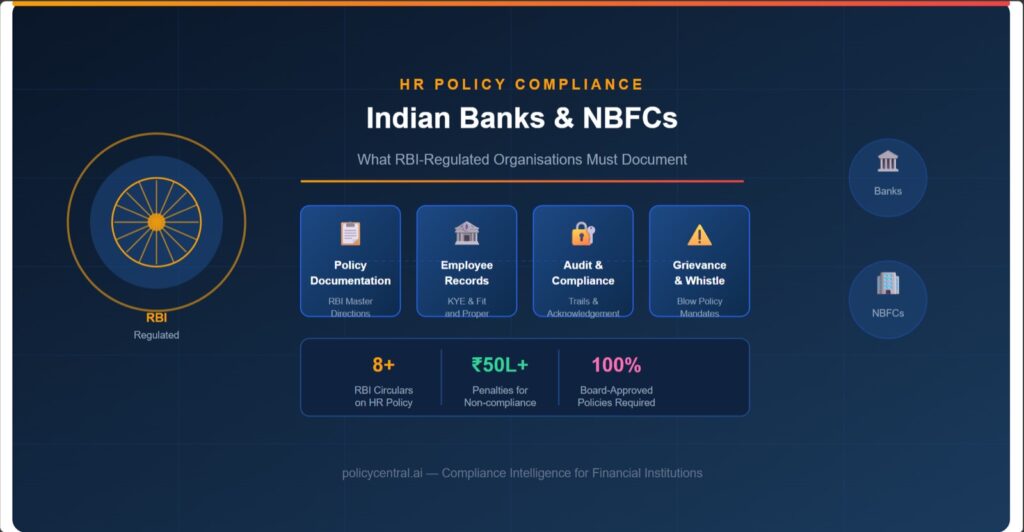
The Reserve Bank of India does not treat HR policies as internal housekeeping. It treats them as a governance instrument. Under various Master Directions, including those on Corporate Governance, Know Your Employee (KYE), Internal Controls, and Compensation, RBI has made it clear: regulated entities must maintain documented, board-approved HR frameworks that are actively implemented, not just filed away.
When the RBI or NABARD conducts inspections, one of the first things they check is whether your policies exist, whether they are current, and whether staff are actually aware of them. A policy that no one has read is, for regulatory purposes, no policy at all. Non-compliance can attract penalties under Section 47A of the Banking Regulation Act, 1949, ranging from monetary fines to supervisory restrictions on business activities.
The Core HR Policies Every Bank and NBFC Must Have Documented
1. Appointment, Fit and Proper Criteria
RBI’s Corporate Governance Master Direction mandates that all Key Managerial Personnel (KMPs), directors, and senior management must satisfy Fit and Proper criteria. This means your HR records must include declarations of financial soundness, annual self-certifications from covered individuals, board-level review records of these certifications, and background verification reports and procedures. This is not a one-time process. It must be documented and renewed, typically annually.
2. Code of Conduct and Ethics Policy
Every RBI-regulated entity needs a written, board-approved Code of Conduct that covers conflict of interest, confidentiality, anti-corruption, and employee obligations. But documentation alone is insufficient. There must be records showing that each employee received the policy, acknowledgements were obtained, refresher training was conducted, and any violations were recorded and acted upon.
Managing this at scale is where most organisations struggle. A mid-sized bank with 2,000 employees across 50 branches cannot rely on email and spreadsheets to track who acknowledged what. This is where platforms with robust employee interaction and acknowledgement capabilities become genuinely valuable, not as luxury tools, but as operational necessities.
3. Compensation and Remuneration Policy
The RBI’s Guidelines on Compensation of Whole Time Directors, Chief Executive Officers, Material Risk Takers and Control Function Staff require NBFCs and banks to maintain documented compensation policies that align pay with risk. The documentation must cover the framework for variable pay and deferral mechanisms, malus and clawback provisions, board-level approval and annual review records, and disclosure requirements for identified material risk takers. For Upper Layer NBFCs specifically, the 2023 RBI circular on compensation governance introduced significant new documentation requirements that many organisations are still catching up with.
4. Know Your Employee (KYE) Policy
KYE is essentially KYC for your own workforce. Banks and large NBFCs are required to maintain policies and records that help them identify internal fraud risks before they become crises. Documentation requirements include periodic employee background re-verification processes, job rotation and mandatory leave policies with records of implementation, sensitive role identification and additional screening, and whistleblower protection linkages.
5. Prevention of Sexual Harassment (POSH) Policy
POSH compliance under the Sexual Harassment of Women at Workplace Act, 2013 requires specific documentation that goes beyond just having a policy. RBI inspection teams have explicitly flagged POSH compliance as a governance indicator. You need a board-approved POSH policy, Internal Complaints Committee (ICC) constitution records and annual reports, training attendance records for all employees, complaint registers even if there are nil complaints, and annual reports filed with the District Officer.
6. Whistleblower and Vigil Mechanism Policy
Under SEBI and RBI guidelines, listed banks and qualifying NBFCs must have a functional vigil mechanism. Documentation includes the policy itself, escalation procedures, and a log of complaints received and outcomes. Keeping this secure, auditable, and accessible only to appropriate personnel is a compliance requirement in itself.
The Documentation That Most Organisations Get Wrong
Here is where the gap between intent and evidence usually appears. Most banks and NBFCs have the policy documents. What they are missing is the layer of proof that sits beneath them.
Having a policy document is not the same as having board approval minutes, a policy document, and a version history together.
- Sending an email blast of a new policy is not the same as maintaining timestamped read receipts and acknowledgement records per employee.
- Running annual training is not the same as keeping attendance logs, assessment scores, and completion certificates.
- Having HR know the policy is not the same as proving that branch-level staff across every location received it.
- Maintaining a grievance email address is not the same as keeping a formal register of complaints, resolution timelines, and outcomes.
The gap is not in intent. Most banks and NBFCs genuinely want to be compliant. They just lack the infrastructure to prove it at the moment of inspection.
How Technology Is Changing HR Policy Compliance
Five years ago, the standard approach was a shared drive folder with policy PDFs and an annual all-hands email. Inspection teams would ask for acknowledgements and compliance teams would scramble to pull together whatever records existed.
That model is breaking down, not because regulators are getting stricter (though they are), but because organisations are getting bigger and more dispersed. An NBFC with 5,000 employees across 200 cities cannot govern policy awareness through email threads.
Modern compliance platforms address this through several mechanisms:
- Automated policy distribution that routes the right policy version to the right employee segment, so a branch manager in a Tier 3 city receives policies relevant to their role and geography. Targeted distribution capabilities make this not just possible but auditable.
- Real-time compliance tracking that gives compliance officers a live view of who has read, acknowledged, or not yet engaged with a policy. Tracking and reporting dashboards replace manual spreadsheet chasing with instant status visibility.
- AI-driven policy intelligence that flags when regulatory updates require policy revisions. Rather than manually monitoring RBI circulars, AI intelligence features can surface relevant updates and map them to existing policy frameworks.
- Enterprise-grade governance that supports multi-entity, multi-branch structures with role-based access controls. For banking groups with multiple subsidiaries, enterprise policy management provides the hierarchy and control needed to manage policies across the entire group.
A Practical Documentation Checklist for RBI-Regulated HR Compliance
If you are conducting an internal audit or preparing for an RBI inspection, here is a working checklist of what you should be able to produce on request:
- Board resolution approving each HR policy, with dates and meeting minutes
- Version history for every policy document
- Distribution records showing when each policy version was shared and with whom
- Individual acknowledgement logs, ideally timestamped with employee ID mapping
- Training attendance and assessment records
- Annual policy review records
- Fit and Proper declarations from all KMPs and directors
- POSH ICC constitution and annual reports
- Grievance and whistleblower complaint registers
- Compensation policy approval and material risk taker identification records
- KYE verification records and sensitive role tracking documentation
Keep in mind: RBI inspections increasingly focus not just on whether policies exist, but on whether they are operationally embedded. A policy that was updated 18 months ago but never re-communicated to staff is a compliance gap, even if the document itself is current.
Key Compliance Takeaways
HR policy compliance in Indian banks and NBFCs has moved well beyond the era of printed policy manuals and annual email reminders. The RBI expects regulated entities to demonstrate not just that policies exist, but that they are genuinely embedded in how the organisation operates, with evidence.
The documentation burden is real. But it is also manageable if you have the right systems in place before the inspector arrives, not after.
Whether you are a compliance head at a large private bank or an HR manager at a growing NBFC, the fundamentals are the same: document your policies properly, distribute them systematically, track engagement rigorously, and keep your audit trail clean. That is not bureaucracy. That is governance.
Frequently Asked Questions
Does every NBFC need the same HR policy documentation as a scheduled bank?
Not exactly, but the differences are narrowing. Base Layer NBFCs have lighter requirements, but Middle Layer, Upper Layer, and Top Layer NBFCs face documentation requirements that are increasingly aligned with banking norms, especially after the 2022 Scale-Based Regulation framework. If your NBFC holds more than Rs. 1,000 crore in assets, expect bank-equivalent scrutiny on core HR governance policies.
How often do HR policies need to be reviewed and re-approved by the board?
Most RBI Master Directions specify annual review as a minimum. However, any significant regulatory update, such as a new circular on compensation or KYE, triggers an out-of-cycle review requirement. The safe practice is to establish a formal policy calendar with board-level approval milestones.
What counts as valid acknowledgement of a policy?
RBI has not prescribed a specific format, but inspection teams generally look for evidence that is individual-level and timestamped. Email read receipts are weak evidence. Digital signatures or in-platform acknowledgements with login-based identity verification are significantly stronger, especially when combined with completion records from policy briefing sessions.
Can a bank use the same policy management platform for both regulatory and internal HR policies?
Yes, and this is increasingly the recommended approach. Using separate systems for regulatory and internal policies creates version control risks and makes compliance reporting more complex. A unified platform with appropriate role-based access controls and audit trails is both operationally simpler and more defensible during inspections.
What happens if there are gaps in our historical acknowledgement records?
First, do not panic, and definitely do not fabricate records. If you are preparing for an inspection, the best approach is to document what you have, flag gaps honestly in your internal review, and show regulators a remediation plan with clear timelines. What regulators respond poorly to is either false documentation or an absence of any remediation effort.
Is there a difference between HR policy compliance and HR regulatory compliance?
Yes, and it matters. HR regulatory compliance covers statutory requirements like the Payment of Gratuity Act, Maternity Benefit Act, Provident Fund, and POSH. HR policy compliance under RBI refers to the governance-level policies, code of conduct, compensation frameworks, KYE, whistleblower mechanisms, that the regulator specifically expects for supervised entities. You need both, and they are tracked separately during inspections.