
For decades, Indian businesses operated under a patchwork of 29 different labour laws. Some dated back to 1936. A few were written before Independence. Together, they were confusing, contradictory, and a compliance nightmare for HR teams.
That era is officially over.
Effective November 21, 2025, the Government of India activated all four consolidated Labour Codes, replacing those 29 laws with a single unified framework. The four codes covering wages, social security, industrial relations, and occupational safety are now legally in force. And whether your company is a 50-person startup or a 5,000-person enterprise, your HR policies almost certainly need to change.
This is not a minor update. This is a structural rewrite.
First, the Basics: What Changed and Why
The government’s goal was to simplify. Too many laws meant too many interpretations, too many compliance gaps, and too much room for disputes. The new framework consolidates everything into four codes.
The Code on Wages, 2019 pulls together the Payment of Wages Act, Minimum Wages Act, Payment of Bonus Act, and Equal Remuneration Act into one clean document. It introduces a uniform definition of “wages” that applies across every calculation, from PF to gratuity to overtime.
The Code on Social Security, 2020 expands the social security net significantly, now covering gig workers, platform workers, and unorganised sector employees. Fixed-term employees gain access to benefits after one year of service, down from five.
The Industrial Relations Code, 2020 raises the threshold for retrenchment and layoff approvals from 100 workers to 300. It also expands fixed-term employment and gives employers more flexibility to respond to operational changes.
The Occupational Safety, Health and Working Conditions Code, 2020 standardises workplace safety rules, introduces free annual medical check-ups for workers above 40, mandates appointment letters for every employee, and formally permits women to work night shifts with consent and proper safeguards.
The immediate question for HR leaders: how does each of these touch the policies sitting in your handbook right now?
The One Change That Hits Payroll Hardest
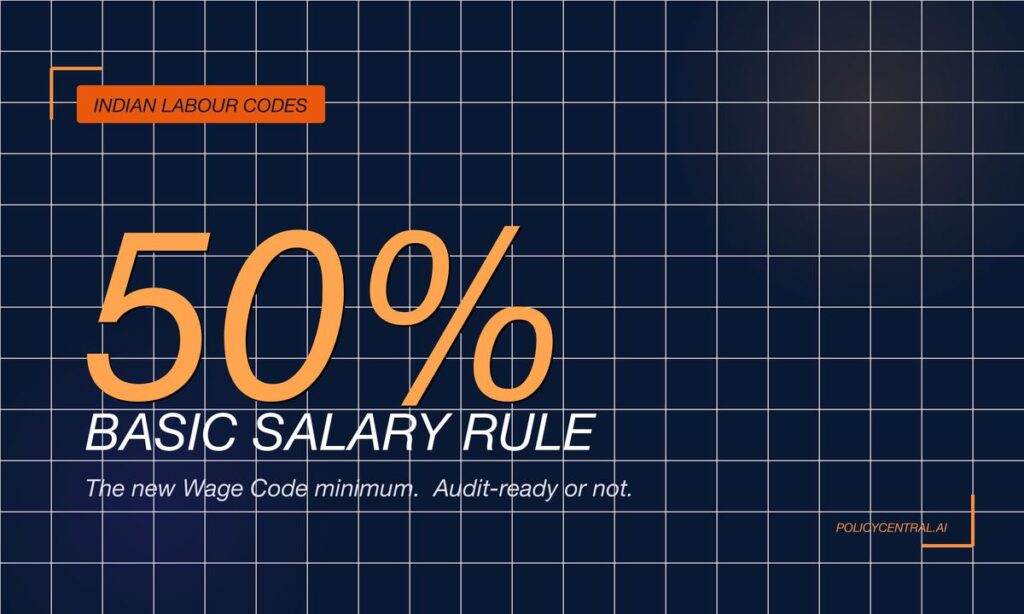
If there is one provision that will force the most urgent policy rewrites, it is the 50% wage rule.
Under the new Wage Code, basic pay must constitute at least 50% of an employee’s total compensation. This sounds simple until you look at how most Indian companies have historically structured salaries.
For years, compensation was built around allowances — HRA, conveyance, medical, special allowance. The basic component was often kept deliberately low because PF contributions, gratuity, and bonus calculations are all tied to basic pay. A lower basic meant lower statutory payouts.
The new rules close that gap. If your current salary structures have basic pay below 50% of gross, they are non-compliant. That means payroll systems need recalibration, PF and gratuity liabilities go up, and offer letters need to be rewritten.
This single change will affect take-home pay calculations, cost-to-company models, and hiring budgets of virtually every mid-to-large employer in India. We have a separate, deeper guide on this: The 50% basic salary rule and how to update your compensation policy before an audit.
What HR Policies Actually Need to Change
Let us be specific. Here are the areas most HR policies will need to address.
Policies, simplified with AI-powered automation
Book a 20-minute demo to see how PolicyCentral.ai streamlines policy creation, distribution, and compliance across your enterprise.
Book a DemoEmployment contracts and offer letters. The OSHWC Code makes written appointment letters mandatory for all employees, not just certain categories. If your company has been issuing verbal agreements or informal offers for contractual or blue-collar staff, that needs to stop immediately. Every worker relationship must be documented.
Working hours and overtime. Shift schedules, maximum working hours, and overtime pay calculations must be revisited. The OSHWC Code tightens record-keeping requirements around time and attendance, making it harder to rely on informal practices.
Fixed-term employment policies. Fixed-term contracts now carry the same benefits eligibility as permanent employment after one year. If your company uses fixed-term arrangements as a way to avoid benefits obligations, that strategy no longer holds. HR policy must reflect this parity. Our companion guide covers this in depth: Fixed-term employee policies under the new Labour Codes.
Leave policies. The codes bring changes to leave entitlements and encashment calculations that must be reflected in your leave policy documentation.
Contract labour and vendor management. The Industrial Relations Code restricts the use of contract labour for core business activities. If your company relies heavily on contractors for functions that could be classified as core, this needs a compliance review and likely a policy revision covering third-party workforce management.
Women’s safety and night shift protocols. With formal permission for women to work nights, companies now need written policies covering consent procedures, transport arrangements, safety protocols, and reporting mechanisms. This is especially relevant for manufacturing, healthcare, and BPO sectors.
Retrenchment and separation processes. The revised threshold of 300 workers for layoff approvals changes how large companies plan workforce reductions. Your HR policy around separations, notice periods, and retrenchment compensation must align with the new rules.
Gig and platform workers. If your business engages freelancers or platform-based workers, the Code on Social Security now applies to you in ways it did not before. Read more: Gig worker policy in 2026.
The Compliance Trap Most Companies Will Fall Into
Here is the part most compliance briefings gloss over. The codes are in force, but the central and state rules that provide granular implementation guidance are still being notified. That creates a transitional grey area where old rules technically continue to apply while companies prepare for the new ones.
This is not a reason to wait. It is a reason to be more careful.
The risk of doing nothing is real. When state rules are finally notified and enforcement begins, companies that have not started the policy rewrite will be caught flat-footed. Retroactive compliance is always more expensive, more disruptive, and more damaging to employee relations than proactive preparation.
The smartest move right now is to treat the codes as the operative standard, audit your existing policies against them, identify gaps, and begin the rewrite with the expectation that implementing rules will bring more specific obligations, not fewer.
Why This Also Breaks the Old Way of Managing Policy
Most Indian companies still manage HR policies in Word documents, email threads, and static PDF handbooks. One version lives in HR’s shared drive. Another is in the onboarding email sent two years ago. A third is being edited by a senior manager for a presentation next week.
When policies are living in documents, they do not actually live anywhere. No one knows which version is current. Distribution is manual. Tracking who has read and acknowledged what is nearly impossible. And when a regulatory change like the new Labour Codes arrives and requires simultaneous updates across multiple policies, the process becomes chaotic.
The new Labour Codes are not just exposing compliance gaps in policy content. They are exposing infrastructure gaps in how policies are managed. We covered this pattern in why companies fail policy compliance.
Companies that have built proper systems around policy tracking and reporting will be in a materially better position to respond. They can identify which policies need updating, push changes to the right people, and create an audit trail showing that employees have been informed. Companies without that infrastructure will be doing this manually, across departments, with all the coordination overhead that implies.
The Role of Technology in Getting This Right
The compliance burden here is not a one-time exercise. The Labour Codes are being implemented in phases. State rules will keep getting notified. Interpretations will evolve. New guidance will emerge. This is a multi-year compliance process, not a single policy sprint.
That kind of ongoing change requires policy infrastructure that can keep pace. A modern policy management platform helps HR teams identify where existing policies conflict with new regulatory requirements, surface gaps that might not be immediately obvious, and draft compliant updated language faster than a purely manual process allows.
This is not about replacing HR judgment. It is about augmenting it. The complexity of simultaneously aligning wage structures, employment contracts, safety protocols, leave policies, and contractor management policies is significant. Technology that helps HR teams navigate that complexity is not a luxury. It is what actually makes the compliance work tractable.
And once policies are updated, the challenge shifts to distribution. Getting the right policy version in front of the right employee, at the right time, with confirmation that it has been seen and understood, is where many companies fail. Targeted policy distribution ensures that a new night shift safety policy actually reaches factory floor supervisors, not just corporate HR inboxes, and that there is a record of it.
What HR Should Be Doing Right Now
If you are in HR or compliance leadership, here is a practical starting point.
Start with a gap audit. Take your existing HR handbook and employment contracts and map them against the four codes. The three highest-priority areas to review immediately are salary structures (the 50% rule), employment documentation (appointment letters), and fixed-term employment policies.
Do not wait for state rules before acting. The central codes set the direction. You can refine policies as state rules arrive, but the fundamental restructuring should begin now.
Involve finance and legal early. The wage structure changes have direct payroll and tax implications. Policy updates that affect compensation should not be made by HR in isolation.
Create a version-controlled policy revision process. Every policy you update should have a clear effective date, an owner, and a distribution list. Informal revision processes will not survive regulatory scrutiny. For the broader picture of what an Indian HR policy library should contain, see our companion piece on HR policies every Indian company should have in 2026.
Communicate changes to employees proactively. A policy rewrite that employees discover only during a dispute is a failure mode. The Labour Codes are significant enough that employees deserve to understand how their compensation, benefits, and working conditions are changing.
The Bigger Shift Underway
The new Labour Codes represent something larger than a compliance event. They represent the government’s intent to formalise India’s workforce at scale. Gig workers and platform workers are getting social security coverage for the first time. Women’s participation in the workforce is being structurally supported. The informal practices that kept large sections of the workforce outside the protection of labour law are being systematically closed.
For companies, this is the moment to decide whether HR policy is a reactive documentation exercise or a genuine governance function. The ones that treat it as governance, that invest in the infrastructure to maintain, update, and distribute policies effectively, will find the new compliance environment manageable. The ones that do not will find every subsequent regulatory change more painful than the last.
The 29 laws are gone. The four codes are here. Your policies need to catch up.
Frequently Asked Questions
When did the four Labour Codes take effect in India?
The Government of India brought all four Codes — the Code on Wages 2019, Code on Social Security 2020, Industrial Relations Code 2020, and Occupational Safety, Health and Working Conditions Code 2020 — into force from November 21, 2025. Several state-level rules under each Code are still being notified, so implementation will continue rolling out through 2026.
Which laws do the four Labour Codes replace?
The four Codes consolidate 29 central labour laws. The Code on Wages replaces the Payment of Wages Act, Minimum Wages Act, Payment of Bonus Act, and Equal Remuneration Act. The Code on Social Security replaces the EPF Act, ESI Act, Payment of Gratuity Act, Maternity Benefit Act, and others. The Industrial Relations Code replaces the Industrial Disputes Act, Trade Unions Act, and Industrial Employment (Standing Orders) Act. The OSHWC Code replaces the Factories Act, Mines Act, Contract Labour Act, and several sector-specific safety laws.
Do the Labour Codes apply to startups and small companies, or only large enterprises?
They apply broadly, but specific obligations kick in at different employee thresholds. The 50% basic-pay definition under the Wage Code applies to all employers regardless of size. Appointment-letter mandates under the OSHWC Code apply to every employee. Threshold-based provisions (such as factory licensing, retrenchment approvals, or standing orders) typically begin between 10 and 300 employees depending on the provision.
What is the very first thing HR should do in response to the Labour Codes?
Run a gap audit on three policies first: salary structures (the 50% basic-pay rule), employment documentation (mandatory written appointment letters), and fixed-term employment policies (now eligible for pro-rata benefits after one year). These three changes have the largest financial and contractual exposure if left unaddressed.
Are companies expected to comply before state rules are notified?
The four central Codes are in force from November 21, 2025, regardless of the pace at which individual states notify their implementation rules. Companies should treat the Codes as the operative compliance standard now. State rules will refine the granular obligations, but waiting for them risks accumulating non-compliance from the date the central Codes took effect.
Do the Labour Codes apply to gig and platform workers?
Yes, but under a separate framework. The Code on Social Security 2020 introduced statutory definitions for gig workers and platform workers and gives them access to social security benefits funded through aggregator contributions. Direct freelancer engagements and platform-mediated work both fall within the framework. We cover this in detail in our gig worker policy guide.
Will employees see lower take-home pay because of the new Wage Code?
In many cases, yes. Raising basic pay to 50% of total compensation increases employee PF contributions (12% of basic) and gratuity accruals. Take-home pay can fall even though CTC stays the same. This makes proactive employee communication essential before the restructured payroll lands in their accounts.