Policies are supposed to bring order to an organization.
They define how people should work, how decisions should be made, and how risks should be controlled. HR policies guide employee behavior. Security policies protect company data. Compliance policies ensure that regulations are followed.
In theory, policies make organizations safer, more consistent, and easier to manage.
In reality, many companies struggle with policy compliance. Employees do not read the policies. Managers interpret them differently. Documents become outdated. During audits, companies scramble to locate the latest version of a policy that should have been easy to find.
The problem is rarely that organizations do not have policies. Most companies have dozens, sometimes hundreds.
The real problem is that policies are not managed properly.
Policy compliance fails not because people intend to break rules, but because the system around policies is broken.
This article explains the real reasons organizations struggle with policy compliance and what companies can do to fix it.
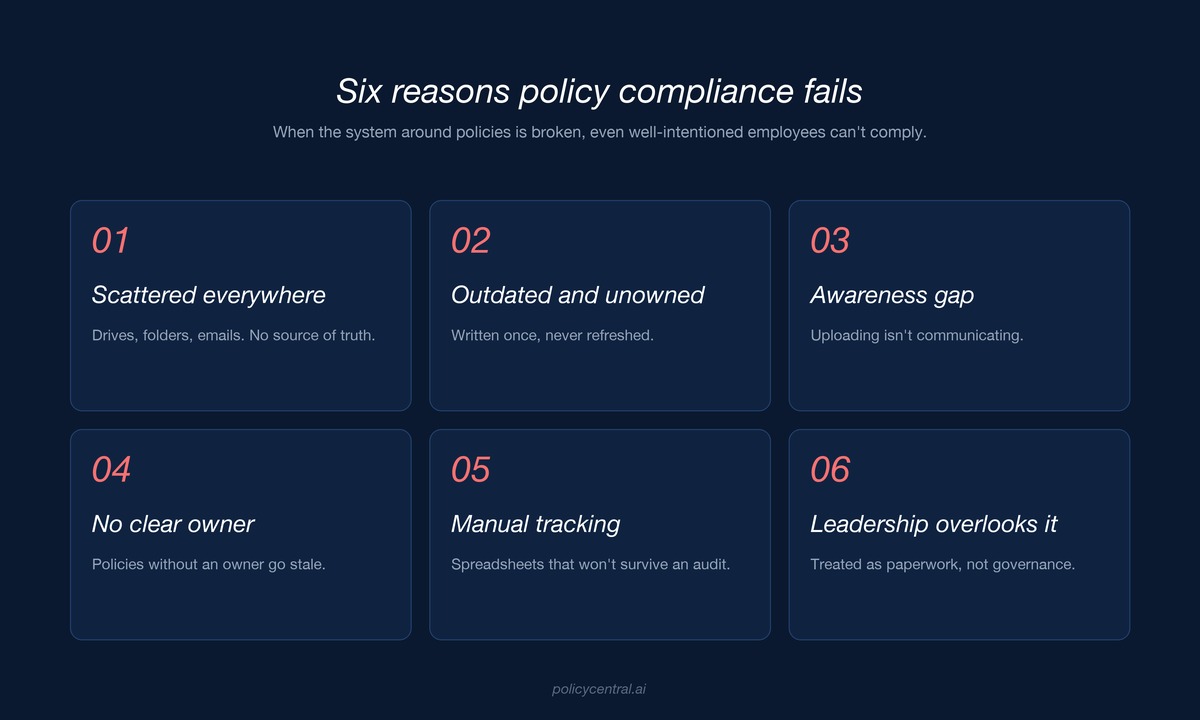
The Hidden Role Policies Play Inside Organizations
Before understanding why compliance fails, it helps to understand why policies matter.
Policies are the operating system of a company. They translate laws, regulations, and internal expectations into everyday rules that employees can follow.
For example:
- HR policies define leave, conduct, and workplace behavior
- Information security policies define how data must be handled
- Procurement policies define how vendors are selected
- Financial policies define approval limits and controls
Without policies, organizations rely on memory, habits, and individual judgment. That might work in a small team, but as companies grow, informal systems break down quickly.
Policies create consistency. They help employees make decisions without asking permission every time. They protect the organization from legal risk. They provide a reference point during disputes or investigations.
But policies only work when employees can find them, understand them, and trust that they are up to date.
When those conditions are missing, policy compliance collapses.
Reason 1: Policies Are Scattered Across Documents and Folders
In many organizations, policies live everywhere.
Some are in shared drives. Others are stored in HR folders. Some are buried inside email attachments. A few exist in PDF documents that nobody remembers creating.
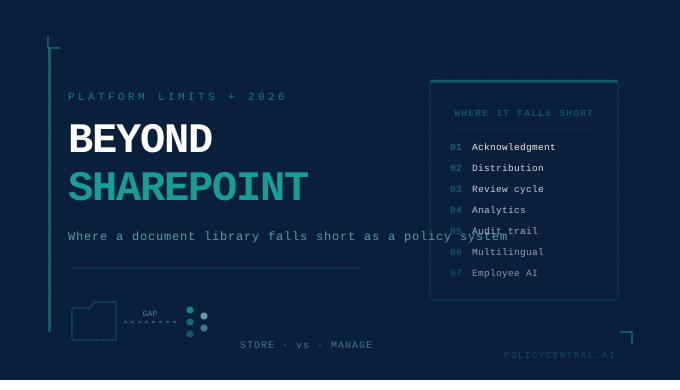
Employees who want to find a policy often face a frustrating search process. They might check Google Drive, SharePoint, internal wikis, or email threads. Sometimes they ask colleagues for the latest version.
This creates a dangerous situation. Different employees may end up referencing different versions of the same policy. One team might follow an updated guideline while another team continues using an outdated document from three years ago.
When policies are scattered, there is no single source of truth. This confusion leads to inconsistent decisions across departments.
A centralized policy repository solves this problem by ensuring that every employee accesses the same document. PolicyCentral.ai’s policy management use case is built around exactly this idea: one location where every policy is stored, organized, and easily accessible.
But without such systems, policy chaos becomes inevitable.
Reason 2: Policies Become Outdated and Nobody Updates Them
A policy written five years ago may no longer reflect the reality of the organization.
Policies, simplified with AI-powered automation
Book a 20-minute demo to see how PolicyCentral.ai streamlines policy creation, distribution, and compliance across your enterprise.
Book a DemoBusinesses evolve quickly. New technologies appear. Regulations change. Work environments shift. Remote work, cloud infrastructure, and AI tools have introduced entirely new risks that older policies never anticipated.
Despite this, many companies treat policy creation as a one-time task. A policy is written, approved, and uploaded somewhere. After that, it slowly fades into the background.
Years later, the policy still exists, but it no longer reflects current practices.
Outdated policies create two serious problems. First, employees may unknowingly violate rules that no longer make sense. Second, auditors and regulators may find gaps between documented policies and actual operations. Both situations create compliance risk.
Effective policy governance requires regular review cycles. Policies must be revisited, updated, and republished when circumstances change. Without structured policy management, these reviews rarely happen. For a concrete example of how a single policy area should be reviewed, see our guide on when to refresh your WFH policy.
Reason 3: Employees Are Not Aware of the Policies
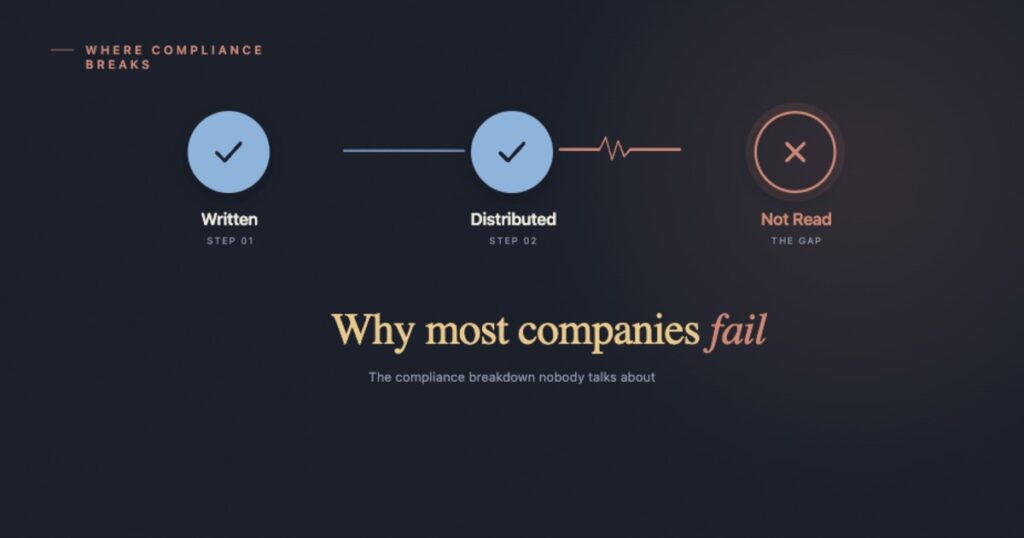
One of the most common compliance failures is simple. Employees do not know the policies exist.
Organizations often assume that uploading a document somewhere automatically means employees will read it. That rarely happens.
Most employees are focused on their daily responsibilities. They are not actively searching for internal policy documents unless something forces them to.
If policies are not clearly communicated, employees may unknowingly violate them. For example:
- An employee may store sensitive customer data in an insecure location because they were never aware of the company’s data protection policy.
- A manager may approve expenses incorrectly because they never saw the updated approval matrix.
These situations are not caused by bad intent. They happen because policy distribution is weak.
Modern policy management systems solve this by actively distributing policies, notifying employees when updates occur, and tracking whether employees have acknowledged the document. Acknowledgement tracking with digital signatures is what turns “we sent the policy” into “we can prove the employee saw and accepted it.”
Without this visibility, organizations cannot confidently claim that employees understand their obligations.
Reason 4: There Is No Clear Ownership or Accountability
Another major reason policy compliance fails is unclear ownership.
Many policies exist without a clearly assigned owner. When nobody owns a policy, nobody feels responsible for maintaining it.
If a regulation changes, who updates the policy? If a department requests clarification, who responds? If the policy becomes outdated, who initiates the revision?
Without defined ownership, policies become static documents rather than living governance tools.
Effective policy frameworks assign responsibility to specific departments or leaders. HR may own employee conduct policies. IT may own security policies. Finance may own procurement and financial controls.
Ownership ensures accountability. It creates a clear process for reviewing, updating, and enforcing policies across the organization. Publisher controls with maker-checker workflows embed this ownership directly into the platform — every policy has a named drafter, reviewer, and approver before it goes live.
Reason 5: Compliance Tracking Is Still Manual
Many organizations still track policy compliance using spreadsheets.
An HR team might maintain a sheet listing employees who acknowledged certain policies. Compliance officers may manually send reminder emails asking employees to review documents.
This approach does not scale. Manual tracking introduces several problems:
- Human error in tracking acknowledgements
- Delayed updates when employees join or leave the company
- Difficulty proving compliance during audits
- Limited visibility for leadership
When auditors ask for proof that employees have acknowledged a policy, organizations often scramble to collect evidence. This creates stress during regulatory inspections or internal audits.
Automated policy management platforms solve this problem by recording policy acknowledgements, tracking compliance status, and generating audit trails. A real-time compliance dashboard means leadership knows the acknowledgement status of any policy at any time, without anyone having to update a spreadsheet.
Reason 6: Leadership Underestimates Policy Governance
Policy compliance is sometimes treated as an administrative task. Leadership teams may assume that writing policies is enough. Once the document exists, they believe the job is done.
In reality, policy governance is an ongoing operational responsibility.
Organizations that treat policies casually often experience repeated compliance failures. Employees interpret rules differently. Managers bypass procedures to save time. Departments create their own informal guidelines.
Without leadership support, policies gradually lose authority.
Effective organizations treat policies as part of strategic governance. Leadership reinforces their importance. Compliance teams are given proper tools. Policy management is integrated into the broader risk management framework.
When leadership signals that policies matter, employees take them seriously.
The Real Consequences of Poor Policy Compliance
Weak policy compliance creates risks that extend far beyond internal confusion. The consequences can be serious.
Legal and Regulatory Exposure
Many industries operate under strict regulations. Financial services, healthcare, and data-driven businesses face complex compliance obligations. The Digital Personal Data Protection Act, RBI guidelines for financial entities, and SEBI requirements for listed companies all demand documented, current policies and proof of employee awareness.
If employees unknowingly violate regulations because policies are unclear or outdated, organizations may face penalties, investigations, or reputational damage.
Inconsistent Decision Making
Without clear policies, different teams make decisions differently. One manager may approve an expense that another rejects. One department may follow stricter controls than another.
This inconsistency creates frustration and undermines fairness. Policies exist to provide a shared standard for decision making.
Audit Failures
During audits, organizations must demonstrate that policies exist and that employees follow them. Standards like ISO 27001 require both the documentation and the proof of implementation.
If auditors cannot find proof of policy acknowledgement or evidence of governance processes, the company may fail compliance checks. Audit failures often reveal deeper weaknesses in internal controls.
Internal Confusion
When policies are difficult to find or understand, employees lose trust in the system. They may stop consulting official policies altogether and rely on informal guidance from colleagues. At that point, policies become symbolic documents rather than operational tools.
How Modern Policy Management Fixes the Problem
The challenges described above are not new. Many organizations have struggled with policy governance for decades. What has changed is the availability of better tools.
Modern policy management platforms bring structure to an area that has traditionally been chaotic. A centralized platform ensures that:
- All policies exist in one organized location
- Employees always access the latest version
- Policy updates are communicated automatically
- Employee acknowledgements are tracked
- Compliance reports are available for audits
For a closer look at what these platforms actually do across the policy lifecycle, see our companion article: What is Policy Management Software?
Instead of relying on scattered documents and manual processes, organizations can manage policies as a structured system. This approach transforms policy governance from a reactive activity into a controlled process.
Policy Compliance Is Ultimately a System Problem
When companies struggle with policy compliance, the instinct is often to blame employees. Managers might say that employees do not read policies or do not care about compliance.
But the deeper issue is usually systemic. If policies are difficult to find, outdated, poorly communicated, or manually tracked, even well intentioned employees will struggle to follow them.
Compliance becomes easier when the system supports it. Clear access to policies, regular updates, automated tracking, and strong leadership support create an environment where compliance becomes the default behavior.
Organizations that treat policy governance seriously do not rely on memory or informal communication. They build systems that make compliance simple.
The Future of Policy Governance
As organizations become more complex and regulations continue to evolve, policy management will only grow more important. Companies will face increasing expectations from regulators, auditors, employees, and customers.
Policies will need to be more transparent, easier to access, and consistently enforced across departments. Organizations that invest in structured policy management will gain a major advantage. They will reduce risk, improve decision making, and build stronger internal governance.
Policy compliance is not about paperwork. It is about ensuring that the rules guiding an organization are clear, trusted, and followed by everyone.
When policies are managed properly, they stop being forgotten documents and start becoming one of the most powerful tools an organization has for maintaining order, accountability, and trust.
Frequently Asked Questions
Is policy compliance really that big a deal, or is it mostly an audit checkbox?
It is both, but the audit checkbox is just the visible part. The bigger costs of weak compliance are silent: inconsistent decisions across teams, HR disputes that hinge on whether an employee was formally informed, security incidents traced back to a policy nobody had read. Audits expose what was already broken; they don’t cause it.
Can we just train employees more frequently instead of changing the system?
Training helps, but it does not address the underlying problem. If a policy is hard to find, outdated, and tracked manually, more training only delays the failure. Training is most effective when it sits on top of a structured system, not as a substitute for one.
What is the difference between “compliance” and “policy management”?
Compliance is the outcome — employees following the rules and the organization being able to prove it. Policy management is the process that makes that outcome possible: writing, approving, distributing, acknowledging, tracking, and updating the policies themselves. Strong policy management makes compliance the natural result; weak policy management makes compliance an annual fire drill.
Whose job is policy compliance — HR, Legal, IT, or Compliance?
All of them, with different policy domains owned by different functions. HR typically owns conduct, leave, and workplace policies. Legal owns contracts and regulatory frameworks. IT and Security own data, devices, and acceptable use. Finance owns procurement and approval limits. The platform-level question — making sure every policy has an owner, an audience, and an acknowledgement record — usually sits with Compliance or HR Operations.
How quickly can a company turn around weak policy compliance?
The technical part is fast. A cloud-based policy platform can be set up in days, and priority policies can be migrated and re-distributed within two to four weeks. The cultural part takes longer. Leadership has to consistently treat policies as governance, not paperwork, for the change to stick. Six months to a meaningful improvement is realistic.
Is this only an issue for regulated industries like banking and healthcare?
Regulated industries feel it sharpest because the failure mode is a regulator’s notice. But the underlying issues — scattered documents, unowned policies, manual tracking, weak distribution — exist in every organization beyond a few dozen employees. The cost shows up differently: HR disputes, ISO audit findings, ESG-reporting gaps, vendor due-diligence failures.
How do we measure whether policy compliance is actually improving?
Three metrics are useful. Acknowledgement rate per policy (the percentage of the targeted audience that has signed off on the latest version). Policy freshness (the percentage of policies reviewed in the past 12 months). And audit-prep time (how many days it takes to produce a regulator-ready evidence pack). All three should trend in the right direction within two quarters of putting a structured system in place.