Most companies in India do not have a policy problem. They have a policy management problem.
The policies exist. They are just scattered across email threads, old SharePoint folders, and PDF attachments that nobody has opened in two years. When an auditor asks for proof of employee acknowledgement, the scramble begins. When a new joiner needs to understand the data handling process, nobody knows which document is the latest version.
Policy management software solves this. It is a dedicated platform for creating, organizing, distributing, and tracking all your company policies across their entire lifecycle. This guide covers what it does, why it matters for Indian organizations right now, and what to look for when choosing one.
The Real Cost of Managing Policies Manually
Before getting into what the software does, it helps to understand what poor policy management actually costs a business.
Audit failures are the most visible consequence. Whether you are going for ISO 9001, ISO 27001, or facing an internal audit, one of the first things auditors check is whether employees have read, understood, and acknowledged key policies. If you cannot produce that record, you fail regardless of how good your actual practices are.
HR disputes are another area where documentation gaps are expensive. In India, workplace disputes that end up at labor courts or internal committees often hinge on whether the employee was formally informed of a policy. Without a timestamped acknowledgement record, your position is weak. For a closer look at what HR documentation should cover, see our guide on the HR policies every Indian company should have in 2026.
Then there is the operational cost. Legal, HR, and compliance teams spend enormous amounts of time chasing policy sign-offs, maintaining version histories, and preparing documentation packages before audits. This is work that should not require human effort at all.
What Policy Management Software Actually Does
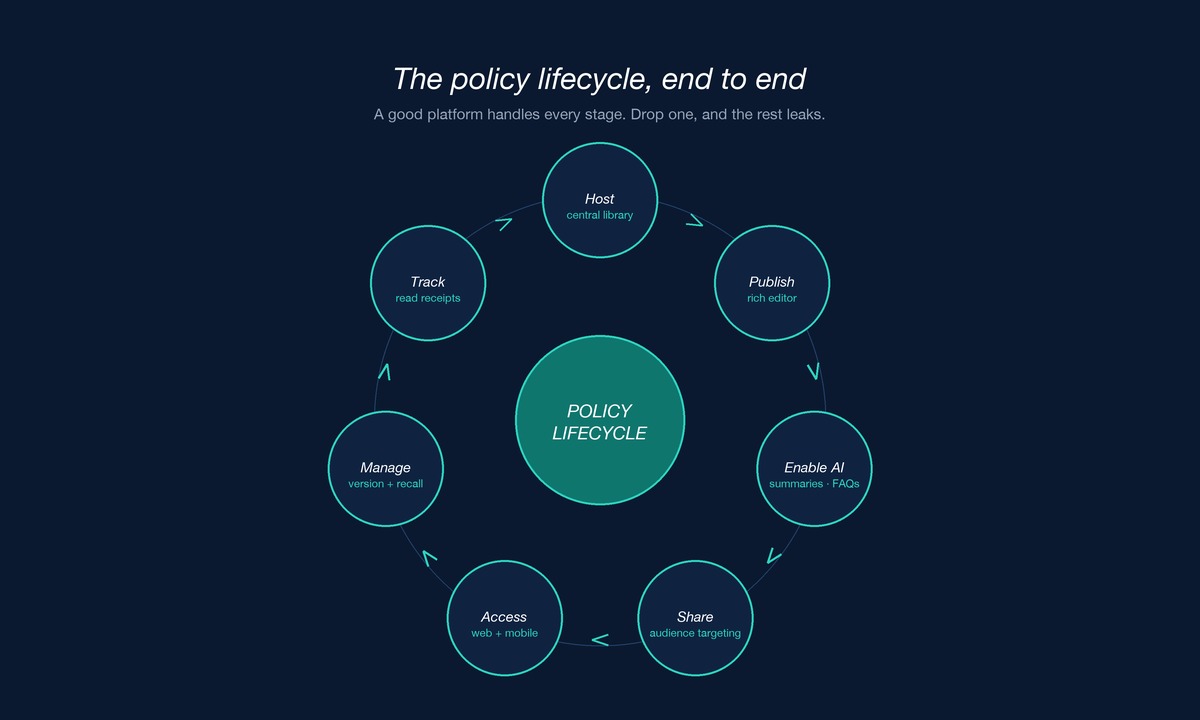
A good policy management platform handles the full lifecycle of a policy, from creation to retirement. Here is what that looks like in practice:
Centralized Policy Library
All policies live in one searchable repository. Employees always access the latest approved version, and older versions are archived with a complete change history. No more version confusion.
Approval Workflows
New policies and revisions go through a defined review and approval chain before they are published. This removes the informal back-and-forth over email and creates a documented approval trail. PolicyCentral.ai’s publisher controls handle this through configurable maker-checker flows.
Policy Distribution and Acknowledgement
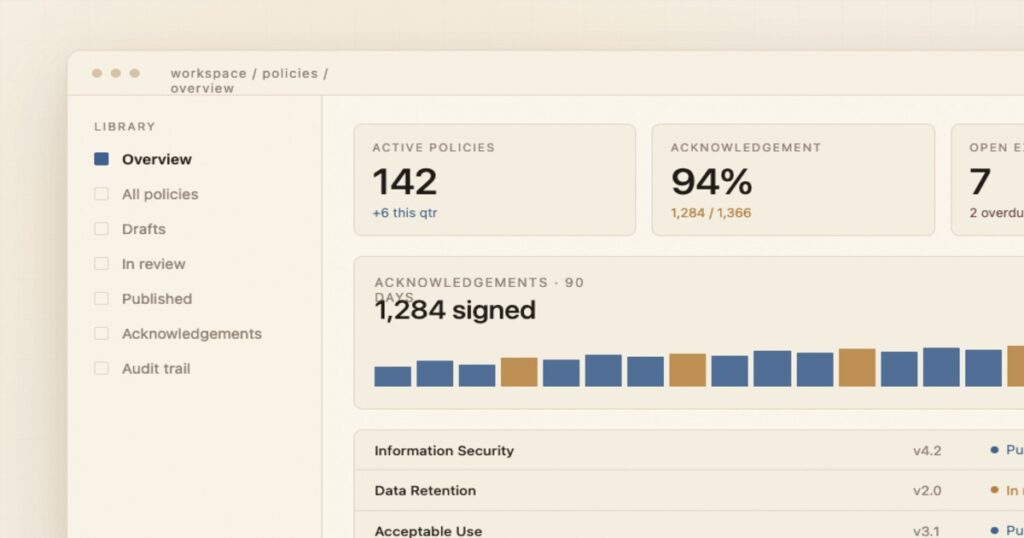
Once a policy is published, the platform notifies relevant employees and tracks who has read and digitally signed it. Reminders go out automatically to those who have not completed the acknowledgement. This is the feature that directly supports audit readiness, and it is why acknowledgement tracking with digital signatures matters more than basic read receipts.
Audit Trails and Reporting
Every action on every policy is logged. Who created it, who approved it, who read it, when it was last updated. When an auditor asks for compliance evidence, you export a regulator-ready report instead of spending three days pulling records together.
AI-Powered Features
Newer platforms use AI to summarize lengthy policy documents, power smart search so employees can find answers quickly, and flag inconsistencies across related policies. AI capabilities like in-policy chat and auto-generated FAQs significantly reduce the time employees spend trying to understand what applies to them — particularly important as policy libraries grow past a few dozen documents.
Why This Matters Specifically for Indian Businesses in 2026
The compliance landscape in India has shifted significantly over the past few years. Several developments are making structured policy management more urgent than ever.
Policies, simplified with AI-powered automation
Book a 20-minute demo to see how PolicyCentral.ai streamlines policy creation, distribution, and compliance across your enterprise.
Book a DemoThe Digital Personal Data Protection Act (DPDP Act) requires organizations to maintain clear, documented policies around data collection, processing, and storage. Having a privacy policy on your website is no longer enough. You need internal policies and proof of employee awareness.
RBI and SEBI regulated entities face increasingly detailed compliance requirements. Banks, NBFCs, and stockbroking firms are expected to demonstrate that operational policies are current, documented, and followed. Manual systems simply cannot keep pace with how frequently these frameworks are updated.
ISO certifications are now a baseline expectation for IT services companies competing for enterprise clients, especially global ones. ISO 27001 in particular requires extensive policy documentation and proof of implementation. Without a dedicated system, maintaining this year-round is impractical. The same applies to ISO 9001 for quality management.
Environmental, Social, and Governance (ESG) reporting is becoming relevant for listed companies and large corporations. Governance policies around ethics, conduct, environmental impact, and social responsibility need to be documented and tracked as part of BRSR disclosures. The same applies to specific HR-statutory policies like the work-from-home policy or your gratuity policy, both of which need structured maintenance to stay compliant.
Who Needs Policy Management Software?
If you are managing more than a handful of policies and more than one team, you need a proper system. The question is not whether the software will be useful. The question is how much it will cost you to keep managing this manually.
Organizations that typically see the most immediate value include financial services companies under regulatory oversight, IT and SaaS businesses pursuing certifications, healthcare organizations handling sensitive patient data, large enterprises with HR, legal, and compliance teams managing dozens of overlapping policies, and manufacturing companies with quality management systems that require documented SOPs.
Growth-stage startups also benefit from building this discipline early. Fixing a disorganized policy culture at 200 employees is far more painful than setting it up correctly at 50.
What to Look for When Choosing One
There are several policy management tools in the market. Here is what separates a genuinely useful platform from one that just digitizes your existing mess:
- Acknowledgement tracking with digital signatures, not just read receipts. You need legally defensible proof.
- Automated workflows for approvals, renewals, and expiry reminders. Manual follow-up defeats the purpose.
- Role-based access controls so sensitive policies are only visible to the right people.
- Comprehensive audit trails that can be exported quickly when needed.
- No complex IT setup. Cloud-based platforms that work across devices are far easier to deploy and maintain, especially for teams that are partially remote or mobile.
- AI capabilities for document analysis and smart search. As policy libraries grow, findability becomes a real problem. AI helps employees get answers without reading through entire documents.
How PolicyCentral.ai Fits Into This
PolicyCentral.ai is built around exactly these requirements. It gives organizations a single platform for the complete policy lifecycle, from creation and approvals through distribution, acknowledgement, and ongoing monitoring, without requiring any server infrastructure or IT overhead.
It includes digital signature support, real-time compliance dashboards, AI-powered document analysis, and audit-ready reporting. For organizations working toward ISO certifications, managing RBI or SEBI compliance requirements, or simply trying to build a more structured governance culture, it covers the full range without the complexity of enterprise-only tools. The security and compliance posture is built for regulated environments — annual VAPT, source code review, SSO, and flexible deployment options including on-premise.
It also works across any device, which is a practical consideration for Indian organizations where teams are often distributed across locations and not always on desktop.
Putting It All Together
Policy management is not a compliance checkbox. It is an operational foundation. Companies that get this right spend less time preparing for audits, have fewer disputes, and build a culture where employees actually know what is expected of them.
The technology to do this well is not complicated or expensive anymore. The question is whether you want to fix this now, or after the next audit finding makes it urgent.
Frequently Asked Questions
What is the difference between policy management software and document management software?
Document management is about storing, organizing, and retrieving files of any type. Policy management is purpose-built for the policy lifecycle: drafting with approval workflows, distributing to specific audiences, capturing legally defensible acknowledgements, and producing audit-ready evidence. A document management system can hold a policy file; it cannot prove who acknowledged it, when, or under which version.
Can we just use SharePoint, Confluence, or Google Drive for this?
They are fine as storage. They do not handle approval workflows, digital-signature acknowledgement, audience-targeted distribution, or audit-trail export. Most importantly, when an auditor asks for proof that 4,127 employees acknowledged Code of Conduct v3.1 on a specific date, a generic file store cannot produce that record. A policy platform can do it in one click.
How long does it take to implement a policy management platform?
For a cloud-native platform with no server infrastructure, the technical setup is days, not months. The longer work is on the customer side — auditing your existing policies, deciding who owns each one, defining audiences and approval chains. Most organizations can be live for their priority policies within two to four weeks.
How does AI help in policy management?
Three places. Auto-generated summaries and FAQs make long policies actually readable. Semantic search lets an employee ask “how many casual leaves do I get?” in natural language and get an answer grounded in the current policy text. And content analysis flags inconsistencies across related policies so a maintenance review surfaces real issues instead of relying on someone remembering them.
What makes a policy “audit-ready”?
Three things. The current version is identifiable and timestamped. Every employee in the audience has either acknowledged it or shows up on a pending list. And every action on the policy — draft, approve, publish, recall, edit — is captured in a tamper-evident log that can be exported in a format the auditor expects. Without all three, the policy might be perfectly written and still fail an audit.
Is this the same as a contract management system?
No. Contract management deals with two-party agreements, negotiation cycles, e-signatures by counterparties, renewal dates, and obligations across the contract term. Policy management deals with internal organizational rules, employee acknowledgement, version control, and compliance evidence. Some platforms serve both; most are purpose-built for one or the other.
Do small businesses really need policy management software, or is it just for large enterprises?
Small organizations can get away without it for longer, but the moment you cross the statutory thresholds that bring POSH, gratuity, EPF, and ESIC into scope (typically 10–20 employees), you have a documented-acknowledgement requirement whether you address it or not. Setting up a structured system at 30–50 employees is significantly easier than retrofitting one at 200.