Every year, thousands of employees across India leave jobs without knowing whether they are owed gratuity, how much it should be, or what their employer is legally required to do. And on the other side, many HR managers process gratuity incorrectly, not out of bad intent, but because the rules are spread across a 1972 law, multiple amendments, and several circular notifications.
This guide puts all of that in one place. Whether you are an employee checking your entitlement, an HR professional setting up a compliant policy, or a founder building your first HR framework, this article covers what the law actually says, in plain language.
What Is Gratuity and Why Does It Exist
Gratuity is a lump-sum payment made by an employer to an employee when the employment relationship ends, as a recognition of long-term service. Think of it as the company saying: “You stayed, you contributed, here is something for the years you gave us.”
It is not a bonus. It is not discretionary. For eligible employees and companies, it is a legal obligation governed by the Payment of Gratuity Act, 1972.
The law was passed by Parliament on August 21, 1972, and came into force on September 16, 1972. Its purpose was to create a minimum financial safety net for workers leaving long-term employment, particularly in industries where retirement benefits were otherwise thin.
Which Companies Must Pay Gratuity
The Act applies to establishments employing ten or more individuals on any single day during the preceding twelve months, creating a legal obligation that persists even if the workforce subsequently falls below this threshold.
This is an important detail. If your company crossed the 10-employee mark even briefly, you are covered permanently. You cannot exit the obligation simply by shrinking the team later.
The Act covers factories, mines, oilfields, plantations, ports, railway companies, shops, and all other commercial establishments. Essentially, if you run a business with at least ten people, gratuity compliance is not optional.
Who Is Eligible for Gratuity
The 5-Year Rule
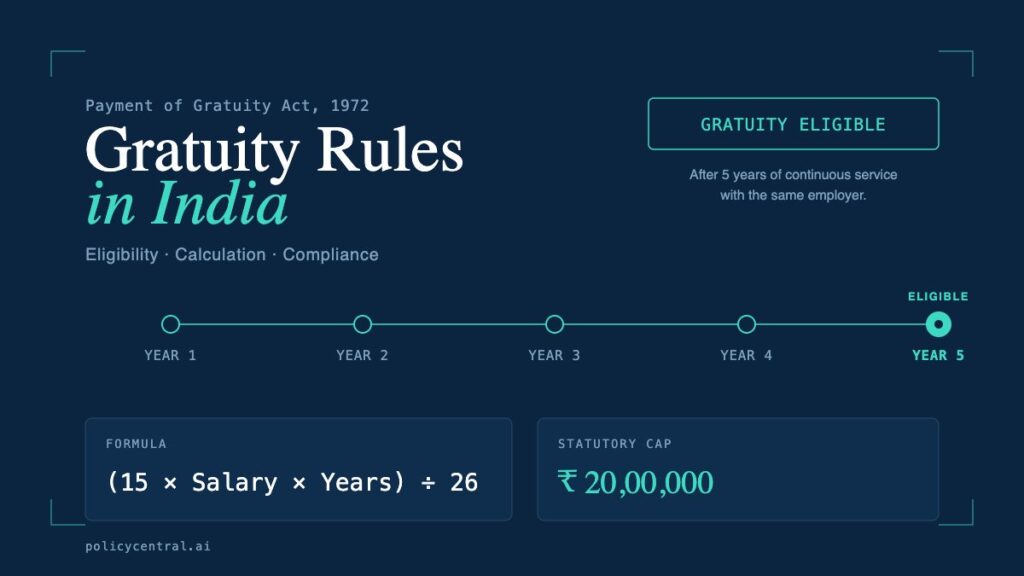
An employee is eligible for gratuity if they have completed 5 or more years of continuous service with the same employer. This condition applies whether the employee has retired, resigned after completing 5 years, attained the age of superannuation, or died or become disabled due to an accident or disease.
Policies, simplified with AI-powered automation
Book a 20-minute demo to see how PolicyCentral.ai streamlines policy creation, distribution, and compliance across your enterprise.
Book a DemoThe Act covers all types of employees: permanent, temporary, contractual, part-time, and seasonal workers. The type of contract does not determine eligibility. Duration does.
What Counts as “Continuous Service”
The Act defines continuous service through Section 2A, where an employee is considered to have rendered continuous service if they have worked for one year comprising 240 working days for establishments involving non-underground work, or 190 days for underground operations such as mining activities. This definition encompasses periods of interruption due to sickness, accident, authorized leave, unauthorized absence, layoff, strike, lockout, or work cessation not attributable to the employee.
This means taking medical leave, going on a sanctioned strike, or being laid off does not break your service continuity. These gaps are absorbed into the calculation, as long as they were not caused by the employee’s own fault.
The Death and Disability Exception
The 5-year rule is waived entirely if the employee dies or becomes disabled due to an accident or disease. In those cases, gratuity becomes payable regardless of how long the person had worked. If an employee dies, gratuity is payable if the employee had completed at least one year of continuous service before death, and the amount goes to the nominated person or, if no nominee exists, to the legal heirs.
The 4 Years 8 Months Question
One of the most commonly asked questions in HR circles: does an employee who has worked for 4 years and 8 months qualify?
If an employee has worked for 4 years and 8 months, they are eligible for gratuity. In this case, the duration is considered as 5 years of continuous service, making the employee eligible for gratuity. However, if an employee has worked for 4 years and 4 months or less, they are not eligible for gratuity.
The rounding rule: if the final year of service exceeds 6 months, it rounds up to a full year. This applies both to eligibility and to the calculation of total service years.
Who Is Not Covered
Apprentices and trainees are not considered employees under the Act and are therefore not eligible. Teachers and staff at educational institutions are not covered unless specifically notified by the central or state government.
How to Calculate Gratuity
For Employees Covered Under the Gratuity Act
The standard formula is:
Here, “last drawn salary” means basic salary plus dearness allowance (DA). It does not include HRA, incentives, or other allowances.
The number 26 represents the average working days in a month (excluding Sundays). The number 15 represents 15 days’ worth of salary per completed year.
Example: An employee has worked for 8 years. Their last drawn basic salary plus DA is Rs. 50,000 per month.
For Employees Not Covered Under the Gratuity Act
Some companies choose to pay gratuity even when not legally required to, or they cover employee grades that fall outside the Act. For these cases, the formula uses 30 instead of 26:
Rounding Service Years
If service in the final year exceeds 6 months, round up to the next full year. For example, 18 years and 7 months is treated as 19 years.
The Maximum Cap
The maximum gratuity amount mandated for private sector employees is Rs. 20 lakh. Originally the limit was Rs. 10 lakh, which was increased to Rs. 20 lakh in 2018. For central government employees, the ceiling is Rs. 25 lakh as of 2024. This means even if the formula calculation yields a higher amount, the employer’s statutory liability is capped at these limits.
Any amount paid above the statutory cap is treated as ex-gratia and is at the employer’s discretion.
What Employers Must Do: Policy and Compliance Requirements
Payment Timeline
An employer must pay gratuity within 30 days from the date it becomes payable. If there is any delay in payment, the employer must pay interest on the amount at a rate notified by the government.
This is not a soft guideline. Delayed payments without valid justification can attract penalties.
Nomination Requirement
After completing one year of service, an employee must nominate a family member to receive gratuity in the event of death. The Act defines family to include spouse, children, dependent parents, and in certain circumstances, dependent siblings. An employee may nominate multiple family members and specify the share of gratuity each nominee should receive. Employees must submit fresh nominations when existing nominees die or when family circumstances change.
HR teams should build nomination collection into their onboarding process. This is often missed, especially in high-growth companies that scale quickly without formalizing HR workflows. A structured onboarding checklist that includes gratuity nomination as a mandatory step can prevent this from slipping through the cracks.
Forfeiture Conditions
Gratuity can be forfeited in specific circumstances. Employers may deny gratuity if the employee is terminated for misconduct, fraud, or damaging the employer’s property. However, forfeiture must be documented, justified, and applied under a due process. It is not a tool to penalize employees simply for resigning or for performance issues.
Employee Application Process
Rule 7 of the Payment of Gratuity (Central) Rules, 1972 requires eligible employees to submit applications in Form I to their employer within thirty days of the gratuity becoming payable. The employer must then process and acknowledge the claim within the statutory timeline.
For HR managers setting up a policy, your employee benefits policy document should include gratuity as a defined section covering eligibility, calculation method, nomination process, and the claims procedure.
Tax Treatment of Gratuity
Gratuity is taxed differently depending on who receives it and from which type of employer.
Government employees: Any gratuity received by central or state government employees is completely exempt from income tax with no monetary ceiling.
Private sector employees covered under the Gratuity Act: The tax-exempt amount is the least of three figures: the actual gratuity received, Rs. 20 lakh, or the eligible gratuity as per the formula. In your entire working life, the maximum tax-exempt gratuity amount you may claim cannot go beyond Rs. 20 lakh. This is a cumulative lifetime limit, not a per-employer limit.
Private sector employees not covered under the Gratuity Act: A similar calculation applies, but the exempt portion is determined using the 30-day formula rather than the 26-day formula.
Any gratuity received above the exempt limit is taxed as income from salaries in the year of receipt.
The 2018 Amendment: What Changed
The Payment of Gratuity (Amendment) Act, 2018 received Presidential assent on March 28, 2018. This amendment doubled the maximum gratuity ceiling from Rs. 10 lakh to Rs. 20 lakh and aligned maternity leave provisions with contemporary requirements. It also empowered the Central Government to revise the gratuity limit through notifications rather than requiring legislative amendments, providing flexibility to address wage inflation without procedural delays.
This means the ceiling can be revised again in the future without a new Act of Parliament. HR teams and compliance managers should subscribe to government labour notifications to stay ahead of such changes rather than relying on periodic audits to catch up.
Practical Situations HR Teams Should Know
Employee resigns after exactly 5 years: Eligible. Calculate using the formula with 5 as the service years.
Employee resigns after 4 years 5 months: Not eligible. Service does not round up to 5 years because the final year is less than 6 months.
Employee resigns after 4 years 7 months: Eligible. Rounds up to 5 years.
Employee is terminated for poor performance (not misconduct): Gratuity is still payable if the 5-year threshold was crossed.
Employee is terminated for fraud or property damage: Gratuity can be forfeited, but the employer must follow due process and document the decision.
Employee dies in year 3: Gratuity is payable to the nominee or legal heir. The 5-year rule does not apply.
What HR Teams Should Build Into Their Gratuity Policy
A well-drafted gratuity policy should cover the following:
- Eligibility criteria (mirroring the Act, or more generous if you choose)
- The calculation formula being used and whether the company pays above the minimum
- Nomination form collection as part of onboarding, with a process for updates
- Claims procedure and the 30-day processing commitment
- Forfeiture conditions and the internal process for invoking them
- Integration with the payroll system so accruals are tracked correctly
- Disclosure in offer letters and CTC breakdowns
Getting this documented protects both the employee who knows their entitlements and the employer who needs defensible processes.
Key Takeaways
Gratuity is one of the most straightforward statutory benefits in Indian labour law, but it is also one of the most commonly misunderstood. The core rules are not complicated: 10 or more employees, 5 years of service, the 15/26 formula, a Rs. 20 lakh cap for private sector, and payment within 30 days. Everything else is context around those anchors.
For employees: know your number, submit your nomination, and do not assume your HR team has it covered.
For HR teams and founders: build this into your systems early. Gratuity surprises at exit are expensive, both financially and in terms of the trust they destroy.
Frequently Asked Questions
Can a company choose not to pay gratuity?
No, if the company meets the eligibility criteria (10 or more employees) and the employee has completed 5 years of service, gratuity is a legal obligation, not a choice.
Does gratuity apply to contractual or part-time employees?
Yes. The Act does not discriminate based on employment type. If the contractual or part-time worker has completed 5 years of continuous service, they are eligible.
Can the company deduct loans or advances from gratuity?
No gratuity payable under this Act shall be liable to attachment in execution of any decree or order of any civil, revenue or criminal court. Gratuity is legally protected. While some employers attempt to adjust dues, the Act protects the gratuity amount from being appropriated in this manner without the employee’s consent.
What if the employer refuses to pay?
If the amount of gratuity payable under this Act is not paid by the employer within the prescribed time, the controlling authority shall, on an application made to it, issue a certificate for that amount to the Collector, who shall recover the same, together with compound interest, as arrears of land revenue. Employees have a legal remedy and do not need to accept non-payment.
Is gratuity part of the CTC?
Many companies include gratuity in the CTC breakdown. The annual gratuity provision is typically 4.81% of the basic salary (derived from the 15/26 formula). However, showing it in the CTC does not change the fact that the employee only receives it upon exit after completing the eligibility period.