If you’ve been tasked with finding the right policy management software for your organization, you already know the rabbit hole it leads to. Demos, sales calls, feature lists that all start sounding the same. And three names that keep showing up: PowerDMS, ConvergePoint, and PolicyCentral.ai.
All three manage policies. But they do it very differently for very different kinds of organizations. This isn’t a sponsored take. It’s a straight comparison of what each platform actually does, where each one shines, and where each one quietly struggles.
Let’s get into it.
PowerDMS: The Compliance Veteran
PowerDMS has been around long enough to be trusted by over 4,000 organizations, mostly in regulated sectors: law enforcement agencies, government bodies, and healthcare systems.
Its strongest selling point is accreditation management, particularly for organizations pursuing CALEA certification (the gold standard for law enforcement). If your compliance team is regularly prepping for inspections and you need documented proof that every officer read every policy update, PowerDMS delivers that paper trail reliably.
The platform handles policy creation, distribution, acknowledgment tracking, and training, all in one place. Electronic signatures, automated reminders, version control, and standard stuff, executed in a way that regulators respect.
Where it starts to show its age: the user experience. Workflow configuration has been described by users as “complex depending on your end goals.” Setup takes time. And critically, there’s no real AI layer here. In 2026, when employees expect to ask a chatbot what their leave policy says instead of digging through a 40-page PDF, that absence is noticeable.
PowerDMS also doesn’t publish pricing, which is a minor frustration if you’re trying to shortlist vendors quickly.
Best for: Law enforcement, fire departments, public sector agencies: any organization where CALEA accreditation or heavy compliance documentation is the primary driver.
ConvergePoint: The SharePoint Specialist
ConvergePoint takes a different approach entirely. It doesn’t replace your document infrastructure; it extends it. Built entirely on top of Microsoft SharePoint and Microsoft 365, it layers policy-specific features onto a stack many organizations already use.
If your IT team lives in M365, the appeal is obvious. ConvergePoint plugs into Word for editing, Outlook for notifications, and Teams for collaboration. Policy creation, review workflows, approval routing, and employee attestations, all within the Microsoft ecosystem, no context-switching required.
The audit trail capabilities are solid. Detailed version histories, automated review cycles, and compliance dashboards give compliance officers the visibility they need. For mid-to-large organizations with mature SharePoint governance, this can feel seamless.
But here’s the catch, and it’s a real one: ConvergePoint is only as good as your SharePoint setup. If your SharePoint is messy, underconfigured, or understaffed, ConvergePoint inherits all of that complexity. Mobile access is limited compared to cloud-native solutions. And for smaller organizations or those outside the Microsoft ecosystem, there’s little reason to consider it.
It’s also geared toward organizations with 100+ employees. Below that threshold, the overhead likely isn’t worth it.
Best for: Mid-to-large enterprises that are already deeply invested in Microsoft 365 and have the IT capacity to manage SharePoint-based infrastructure.
PolicyCentral.ai: The AI-Native Challenger
PolicyCentral.ai is the youngest of the three, and the one most deliberately built for where policy management is going, not where it’s been. Built by WorkApps (the team behind VideoCX.io, which processes 3M+ video calls monthly for 75+ financial institutions), PolicyCentral.ai brings a product sensibility shaped by enterprise banking and insurance requirements. The platform is venture-backed and headquartered in Pune with a US subsidiary.
Policies, simplified with AI-powered automation
Book a 20-minute demo to see how PolicyCentral.ai streamlines policy creation, distribution, and compliance across your enterprise.
Book a DemoHere’s what sets it apart.
AI That Actually Does Something
Most platforms have “AI” bolted on. PolicyCentral.ai was designed around it from the start. The AI intelligence features, powered by AWS Bedrock and Amazon Lex include automatic policy summarization, FAQ generation from policy content, translation in 10 Indian languages & text to speech, readability optimization suggestions, infographic creation from complex clauses, and quiz generation for comprehension checks.
The crown jewel is PolicyGPT, a conversational chatbot that lets any employee ask natural language questions like “How many casual leaves can I carry forward?” and get an answer sourced directly from the relevant policy document. This is the difference between a policy that gets read and a policy that actually gets understood.
Distribution That Knows Your People
Getting the right policy to the right employee sounds simple. In practice, it’s one of the biggest compliance failures: wrong audience, missed joiners, manual spreadsheet chaos.
PolicyCentral.ai’s smart distribution and targeting syncs directly with your Active Directory or HRMS. Target by department, location, grade, designation, or individual. There’s even an Evergreen mode: enable it, and every new joiner who matches the target profile automatically receives the relevant policy when they join. No manual intervention needed.
There’s also a mail-merge-style function that lets you send different content to different employees within the same policy send, something that sounds mundane until you’ve tried to manage location-specific policy variants at scale.
Engagement, Not Just Acknowledgment
Most policy tools stop at “employee clicked acknowledge.” PolicyCentral.ai’s employee interaction features go further: e-signatures, inline comments, response buttons, and even emoji reactions on policies (which sounds frivolous until you see how much higher engagement rates get).
This matters because acknowledgement without comprehension is just legal CYA. The goal is an organization where people actually know what the policy says.
Reporting That Closes the Loop
The tracking and reporting suite provides real-time compliance dashboards: who read it, who hasn’t, which departments are lagging, which policies are approaching expiry. Search analytics show you what employees are actually looking for, a useful signal for which policies need clearer language.
Enterprise-Grade Infrastructure
The enterprise features include a white-label mobile app (published under your own brand on iOS and Android), SSO, multi-department support, Active Directory integration, and a full API for custom integrations. The platform is cloud-hosted but supports flexible deployment including on-premise options for data-sovereign requirements.
On the security and compliance side: AES-256 encryption, VAPT-tested infrastructure, IP restriction, granular audit logs, and role-based access controls. For banks and insurance companies where data handling is non-negotiable, this is the kind of spec list auditors want to see.
Best for: Large enterprises, banks, insurers, and any organization that wants policy management to feel like a modern SaaS product rather than a compliance checkbox.
Feature-by-Feature: The Honest Grid
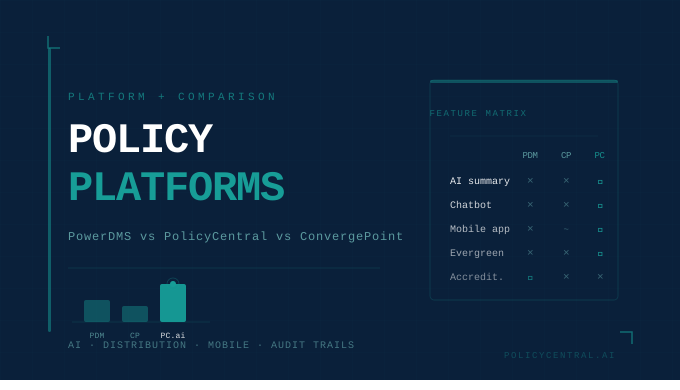
| Feature | PowerDMS | ConvergePoint | PolicyCentral.ai |
|---|---|---|---|
| AI-powered summaries | ✗ | ✗ | ✓ |
| Chatbot Q&A for employees | ✗ | ✗ | ✓ (PolicyGPT) |
| HRMS/AD-synced targeting | Limited | SharePoint only | ✓ Full sync |
| White-label mobile app | ✗ | ✗ | ✓ |
| Accreditation management | ✓ (CALEA) | ✗ | ✗ |
| Training integration | ✓ | ✗ | Via integrations |
| Audit trails | ✓ | ✓ | ✓ |
| Cloud-native | ✓ | ✗ (SharePoint) | ✓ |
| Evergreen auto-distribution | ✗ | ✗ | ✓ |
| Employee engagement tools | Basic | Basic | Rich |
| Independent of Microsoft stack | ✓ | ✗ | ✓ |
| Pricing transparency | ✗ | ✗ | Request demo |
The Real Question: Which One Is Right for You?
If your organization is a police department or public health agency and accreditation management is your north star, PowerDMS is the safe, proven choice. The implementation complexity is a real cost, but the feature set for that specific use case is mature.
If your organization is fully committed to Microsoft and your IT team already manages SharePoint perfectly, ConvergePoint makes sense as an extension of your current setup instead of a brand-new tool.
If you’re a bank, insurer, or large enterprise with multi-location teams, multilingual requirements, or a compliance function that needs to show regulators not just that policies were sent but that employees actually engaged with them, PolicyCentral.ai is the honest answer for 2026. The AI layer isn’t a future roadmap item; it’s live and functional. And the infrastructure is built for exactly the kind of scale and auditability that regulated industries demand.
Frequently Asked Questions
Can PolicyCentral.ai replace our current HRMS or Active Directory?
No, and it doesn’t try to. It integrates with your existing AD/HRMS and syncs employee profiles automatically. Think of it as sitting on top of your HR stack, not replacing it.
Does PowerDMS work for industries outside public safety?
Yes, but its strongest features, particularly CALEA accreditation support, are purpose-built for public safety. Teams in other industries will find it functional but may feel like they’re paying for tools they don’t use.
Is ConvergePoint viable for a company that doesn’t use SharePoint?
Not really. Its entire architecture depends on SharePoint as the underlying platform. Organizations starting fresh with policy management software would be better served by a standalone cloud solution.
What does “Evergreen mode” in PolicyCentral.ai actually mean?
It means you set the targeting criteria for a policy once. Any new employee who matches those criteria (say, all new Finance hires in the Mumbai office) automatically receives the policy when they join, without anyone manually triggering a send.
Is PolicyCentral.ai suitable for companies with data residency requirements?
Yes. Flexible deployment options, including on-premise hosting, are available for organizations that need data to stay within specific geographies. This is particularly relevant for BFSI customers in India and Southeast Asia.
How does PolicyGPT work, and is it connected to the internet?
PolicyGPT operates on your organization’s own policy documents, not the open internet. It uses conversational AI (Amazon Lex + Bedrock) to answer employee questions with citations from your own published policies.
Does ConvergePoint have mobile app support?
ConvergePoint’s mobile access relies on SharePoint’s mobile capabilities, which are limited compared to cloud-native solutions. PolicyCentral.ai, by contrast, offers a fully white-labeled mobile app for iOS and Android published under your brand.