For an insurer, the word policy carries two meanings. There is the insurance policy sold to a customer, and there is the internal governance policy that tells the organization how to run itself. This article is about the second kind, and about a shift that has made it far harder to manage.
In 2024, the IRDAI moved insurer governance from guidance to law. The IRDAI (Corporate Governance for Insurers) Regulations, 2024, and the accompanying Master Circular, were the first time these governance expectations were issued as binding regulations rather than guidelines. The practical consequence for compliance teams is direct: the stack of board-approved policies an insurer must maintain, keep current, cascade to its workforce, and prove engagement on has grown, and the standard of proof has risen with it.
The stack of board-approved policies an insurer must maintain
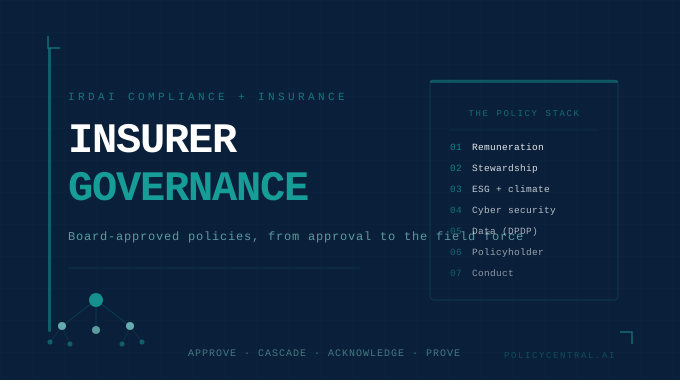
Under the 2024 governance framework, an insurer’s board carries explicit responsibility for a set of formal, board-approved policies. These include a comprehensive remuneration policy covering the chairperson, non-executive directors, and key management persons, a stewardship policy, and an ESG framework that extends to climate risk management.
Around these sit the structures the regulations require: mandated board committees, including Audit, Risk Management, and Policyholder Protection, Grievance Redressal and Claims Monitoring, and a clear insistence on the independence of control functions, namely compliance, risk, audit, actuarial, and secretarial. The framework also fixes a minimum tenure for the Chief Compliance Officer, signaling that compliance is meant to be a durable function rather than a rotating assignment.
Each of these is a document that has to be written, approved, versioned, and reviewed. And each is only as effective as the organization’s ability to put it in front of the people it governs.
Cyber and data: the fastest-growing policy obligations
Governance is only part of the picture. The IRDAI Information and Cyber Security Guidelines, 2023 require every insurer to maintain a board-approved Information and Cyber Security Policy, reviewed periodically, supported by a defined risk assessment carried out at least annually. These obligations extend beyond the insurer to the intermediaries and entities that handle policyholder information.
Layered on top is the Digital Personal Data Protection Act, which brings its own set of data-handling policy requirements for an industry that processes sensitive personal and health information at scale. For an insurer, cyber and data obligations are now among the fastest-moving parts of the policy library, which means they are also the parts most likely to fall out of date between reviews.
The real challenge is not writing the policy. It is the last mile.
Most insurers can draft a compliant policy. The board approves it, compliance files it, and on paper the obligation is met. The difficulty is everything that happens after approval.
Policies, simplified with AI-powered automation
Book a 20-minute demo to see how PolicyCentral.ai streamlines policy creation, distribution, and compliance across your enterprise.
Book a DemoAn insurer is not a single office. It is a head office, a network of branches, and a large, distributed field force of agents and intermediaries. When the board approves a revised conduct policy or an updated information security policy, that document has to reach every relevant person in that network, in a form they can read, and it has to come back with a record that they received and understood it. That last mile, from board approval to workforce acknowledgment, is where policy compliance actually succeeds or fails. It is the same distribution and acknowledgment challenge we examined for banks and NBFCs, amplified by the scale and dispersion of an insurance distribution network.
Doing this over email and shared drives does not scale, and it does not produce the kind of evidence a regulator now expects. A bulk acknowledgment collected months ago tells you a file was sent. It does not tell you the current field force understood the current policy.
The language reality insurers cannot ignore
An insurance distribution network in India is multilingual by nature. Agents and branch staff across states read and work in Hindi, Tamil, Bengali, Marathi, and more. IRDAI itself recognizes this: its own Master Circular on Corporate Governance was published in both Hindi and English.
A governance or conduct policy delivered only in English to a field force that operates in regional languages is a policy that a large part of the network cannot genuinely follow. Delivering and tracking acknowledgment in the languages employees actually read has moved from good practice to a compliance necessity, and for insurers with a wide agency footprint it is unavoidable.
Audit-readiness: proving engagement, not possession
The through-line across the governance regulations, the cyber guidelines, and the DPDP Act is a rising standard of proof. Regulators are less interested in whether a policy exists and more interested in whether it worked: was it current, did it reach the right people, did they engage with it, and can you demonstrate all of that on demand.
That is a documentation and evidence problem as much as a governance one. When an examiner asks for proof that the field force acknowledged the latest information security policy, the answer should be a live report, not a three-week evidence-collection exercise across branches. Building that capability in advance is exactly what a structured policy audit checklist is designed to force.
How a policy intelligence platform helps insurers
A purpose-built policy management platform addresses the last-mile problem directly. It distributes each board-approved policy to precisely the right audience across head office, branches, and the agency network, syncing with the insurer’s HR and identity systems so the distribution reflects the current workforce rather than a stale list.
It delivers and tracks acknowledgment in multiple Indian languages, captures genuine engagement rather than mechanical sign-off, and maintains a tamper-evident audit trail that shows who acknowledged which version of which policy and when. For the fast-moving cyber and data policies, automated review reminders and evergreen distribution to new joiners close the gaps that manual processes leave open. The broader set of capabilities that separate a genuine platform from a document store is covered in our guide to the seven features of a policy intelligence platform.
PolicyCentral.ai was built for the Indian regulatory reality, with ten-language delivery, HRMS-synced distribution, and audit-ready records designed for the standard of proof that IRDAI, the DPDP Act, and sector rules now demand. If your compliance team is managing a growing governance policy stack across a dispersed insurance network, request a demo and bring the policy you find hardest to get acknowledged across the field force.
Frequently Asked Questions
What did the IRDAI Corporate Governance Regulations, 2024 change for insurers?
They moved insurer governance expectations from guidelines to binding regulations for the first time. Insurers must maintain a defined set of board-approved policies, including remuneration, stewardship, and ESG frameworks, constitute mandated board committees, ensure the independence of control functions such as compliance and risk, and meet a rising standard of proof that these policies are current and effective.
Does IRDAI require a formal information security policy?
Yes. The IRDAI Information and Cyber Security Guidelines, 2023 require every insurer to maintain a board-approved Information and Cyber Security Policy, reviewed periodically, supported by a risk assessment conducted at least annually. These obligations also extend to intermediaries and entities that handle policyholder information.
Why is policy distribution harder for insurers than for other companies?
Because an insurer operates through a head office, a branch network, and a large, geographically dispersed field force of agents and intermediaries, often working in different regional languages. Getting a board-approved policy to every relevant person in that network, in a language they can read, and collecting a defensible acknowledgment record, is a significant last-mile challenge that email and shared drives cannot meet at scale.
Do insurers need to provide policies in regional languages?
In practice, yes. A distribution network that operates in Hindi, Tamil, Bengali, Marathi, and other languages cannot genuinely follow a governance or conduct policy delivered only in English. IRDAI publishes its own key circulars in Hindi and English, and multilingual delivery with tracked acknowledgment has become a compliance necessity for insurers with a wide agency footprint.
What does IRDAI audit-readiness require for policies?
It requires evidence that a policy was current, reached the right audience, and was genuinely engaged with, all producible on demand. Rather than assembling proof across branches after an examiner asks, insurers need a live, tamper-evident record of who acknowledged which version of each policy and when, which is what a dedicated policy management platform is designed to maintain.
How can PolicyCentral.ai help an insurance company with IRDAI compliance?
PolicyCentral.ai distributes board-approved policies to the precise audience across head office, branches, and the agency network, delivers and tracks acknowledgment in ten Indian languages, maintains tamper-evident audit trails, and automates review reminders for fast-moving cyber and data policies. This directly addresses the last-mile distribution, acknowledgment, and evidence challenges that IRDAI’s governance and cyber security requirements create.