Think about the last time your organisation faced a compliance incident. Someone did something they weren’t supposed to do, or failed to do something they were supposed to. Almost always, when you pull the thread, it leads back to the same place: a policy that nobody actually read, understood, or remembered.
That is not a people problem. That is a visibility problem.
Chief Compliance Officers today are being asked to do something genuinely difficult: prove that policies are actively working, not just existing. Regulators want data, auditors want evidence, and boards want absolute assurance. A scattered folder of PDF sign-offs or a spreadsheet tracker isn’t going to cut it anymore.
A modern policy analytics and reporting dashboard changes that equation. It turns your compliance programme from a faith-based exercise into a metrics-driven system. When you know which specific numbers to watch, you stop firefighting and start managing risks before they escalate.
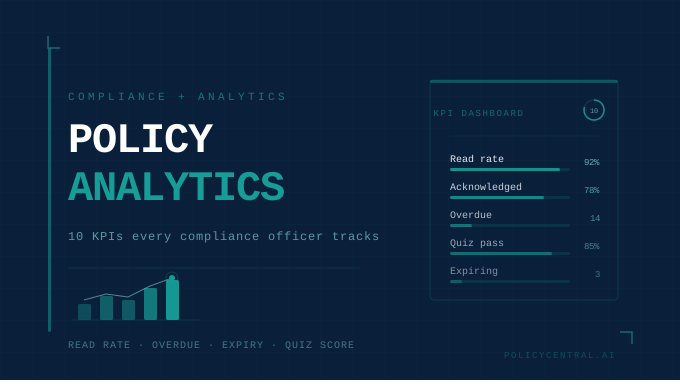
Here are the ten key performance indicators that serious compliance leaders track on their dashboards and why each one matters to your organisation.
1. Policy Read and Acknowledgment Rate
This is the foundational metric that most teams already track, but still somehow miss the real value of. The read and acknowledgment rate measures the percentage of employees who have opened, read, and digitally confirmed their understanding of a given policy within your defined compliance window. The deeper insight lies beneath the headline number. A high company-wide average can easily hide a dangerously low completion rate within a single high-risk business unit or factory floor. A robust Policy Acknowledgment Feature helps you segment this data instantly, allowing compliance teams to prove policy communication during audits while identifying the exact pockets of the workforce that are lagging behind.
2. Unread Policy Risk Score
An aggregate metric that acts as an early warning system for organizational liability. Instead of waiting for a dispute to surface, this score calculates your compliance exposure by identifying which high-stakes policies have the highest percentages of unread status across specific departments, branches, or employee grades.
Knowing your vulnerability before an incident occurs is considerably more useful than discovering it during a legal dispute. Tracking a dynamic Unread Policy Risk Score allows compliance teams to target interventions and spot compliance exposure well before an external audit or statutory inspection takes place.
3. Pending Acknowledgment List
This KPI tracks compliance velocity by monitoring the specific individuals, branches, or departments that have failed to acknowledge mandatory policies past the deadline. High overdue rates often cluster around specific managers or geographies, and that clustering tells an important story about regional communication bottlenecks.
Policies, simplified with AI-powered automation
Book a 20-minute demo to see how PolicyCentral.ai streamlines policy creation, distribution, and compliance across your enterprise.
Book a DemoAn unresolved pending list is what converts manageable operational gaps into severe audit findings. Maintaining a real-time view of this metric helps compliance functions reduce audit and legal risk quickly by pinpointing exactly where reminders need to be escalated.
4. Expiring Policies Dashboard Status
Policies are living documents that must evolve alongside legal frameworks. This metric tracks documents that are approaching their expiration dates or are currently pending a mandatory review or renewal cycle.
Allowing outdated policies to remain active within an organisation creates immense legal liability, especially after major regulatory shifts. Utilizing a dedicated Expiring Policies Dashboard prevents stale documentation from governing employee behavior, ensuring the workforce is always aligned with current, legally accurate operational guidelines.
5. Most Accessed Policies
An incredibly revealing operational metric that shows which policies employees search for and access most frequently via your internal repository.
When a specific policy sees exceptionally high engagement, it generally means employees are treating it as a functional reference tool or the content is confusing and requires simplification. Tracking these access patterns helps compliance teams identify which policies are operationally vital and where clear, plain-language rewrites are necessary to support daily decision-making.
6. Least Read and Ignored Policies
The exact flip side of user engagement, this KPI highlights policies with near-zero reading or interaction rates across the organisation.
Very low engagement often indicates severe internal communication gaps or redundant policy content that no longer applies to the daily realities of the workforce. By monitoring ignored documents, compliance leaders can systematically clean up the corporate library and re-evaluate how critical updates are broadcasted to staff.
7. Department-wise Compliance Completion
Company-wide compliance averages are often deceptive. This metric breaks down acknowledgment trends by department, geographic location, branch, or business unit to give a clear picture of internal alignment.
If a single manufacturing plant or regional branch is consistently trailing behind the rest of the enterprise, it signals a deeper localized management or access issue. Monitoring department-wise trends allows compliance officers to identify non-compliant teams or regions quickly and deploy targeted training resources where they are needed most.
8. Employee Engagement with Policy Content
True compliance goes beyond a single digital signature. This KPI tracks deeper qualitative interaction indicators within the platform, including time spent reading an article, feedback submitted, and specific questions asked by employees.
These interaction signals measure whether employees are actually consuming and digesting the policy content effectively. When employees actively submit clarifications or leave feedback, it transforms your policy portal from a corporate formality into an interactive, risk-mitigating resource.
9. Policy Quiz and Awareness Scores
An acknowledgment proves an employee clicked a button; a comprehension score proves they understood the rule. For high-stakes regulations involving financial controls, data handling, or workplace safety, embedding short knowledge checks is rapidly becoming an industry best practice.
Analyzing employee quiz scores and overall policy understanding levels provides the definitive data required to prove compliance awareness during internal or external audits. If a specific team shows a low first-attempt pass rate on an anti-bribery quiz, it tells the compliance function to simplify the document text rather than blame the workforce.
10. Reminder and Escalation Effectiveness
This metric measures the operational health of your internal compliance campaigns by tracking how many employees successfully complete their acknowledgments after receiving automated nudges and escalation alerts.
If your follow-up workflows require heavy manual intervention from HR or legal teams, the compliance delivery model is broken. Tracking the conversion rate of automated notifications helps you optimize your reminder cadence, reduce the administrative burden on managers, and ensure rapid workforce completion.
The Role of Multi-Language Policy Usage Analytics
For large enterprises, manufacturing hubs, and the BFSI sectors, particularly across linguistically diverse regions like India, tracking policy engagement by language is a critical necessity. Relying strictly on English documentation creates massive compliance blind spots among frontline or factory floor workers.
Advanced platforms solve this by tracking adoption and acknowledgment across regional language versions. Monitoring multi-language usage analytics ensures that critical safety mandates, standing orders, and operational protocols are fully understood by every segment of the workforce, satisfying both state-level communication requirements and corporate risk standards.
Moving Beyond Reactive Compliance
Numbers on a screen do not magically make an organisation compliant. What they do is give you the precise information required to act before something goes wrong rather than after.
The Chief Compliance Officers who manage risk effectively are the ones who treat their analytics dashboard as an active management tool, not a static reporting template. They use these metrics to monitor trends, investigate drops, and ask critical questions about why certain teams are exposed.
Managing policy compliance through shared drives, email chains, and manual spreadsheets leaves an organisation highly vulnerable to audit failures. Shifting to a dedicated policy management system, and building audit-ready processes, creates an unalterable audit trail, automates the distribution lifecycle, and generates audit-ready reports at the click of a button.
If you want to see how PolicyCentral.ai supports policy audit readiness, reduces unread policy risk, and automates acknowledgment tracking across your entire employee base, request a demo today.
Frequently Asked Questions
What is a policy analytics dashboard?
A policy analytics dashboard is a centralized intelligence hub that tracks the real-time status, health, and operational visibility of your organization’s compliance program. Instead of managing static files, it aggregates critical metrics like read rates, pending lists, and departmental completion trends to give Chief Compliance Officers an immediate view of compliance exposure across the entire workforce.
Which KPI matters most for regulatory audits and inspections?
While every metric serves a purpose, your current policy read and acknowledgment rate combined with your policy quiz awareness scores are the most heavily scrutinized during an audit. Labor authorities, statutory inspectors, and external regulators want concrete, timestamped evidence demonstrating that your workforce has actively consumed and understood current guidelines, rather than a paper trail that stopped years ago.
How often should a compliance officer review their analytics dashboard?
For high-risk policy areas like POSH compliance, financial controls, and data security, monitoring analytics weekly helps catch operational gaps early. For broader operational rules, monthly reviews are generally sufficient. Modern compliance systems remove the burden of manual monitoring by triggering automated alerts the moment a department’s pending acknowledgment rate drops below your compliance threshold.
Can growing organizations with smaller HR and compliance teams benefit from these metrics?
A metrics-driven compliance approach is not dependent on company size; it is dependent on the complexity and liability of your operational environment. Even a small compliance team managing a few hundred employees across different locations or language preferences benefits immensely from automated dashboards, as it eliminates manual email chasing and spreadsheet errors.
What is the difference between a policy acknowledgment rate and an awareness score?
An acknowledgment rate confirms a baseline transaction—proving that an employee opened a document and digitally signed off on it. A policy awareness score is driven by embedded comprehension quizzes that measure true understanding. In regulatory and dispute contexts, having an acknowledgment trail without measurable comprehension creates an operational liability, which is why monitoring both metrics is essential.
How do multi-language analytics protect distributed operations?
In linguistically diverse operating environments, tracking policy adoption across regional language variations ensures your mandates actually reach frontline or factory floor workers. This metric prevents critical communication gaps in high-risk zones, helping HR and compliance officers satisfy both state-level standing order requirements and corporate risk standards simultaneously.