Most HR teams do not think of their Google Drive folder as a liability. It sits there, organised by quarter, maybe colour-coded by someone who no longer works at the company. It feels fine. Manageable. And then something goes wrong.
An employee gets disciplined under a leave policy that was quietly updated eight months ago. Nobody told them. The manager enforcing it did not know either, because the updated version lived in a subfolder that only two people had bookmarked. The old version was still floating around in a thread from last year, forwarded so many times it had lost its original context.
This is not a horror story. This is Tuesday.
The Shared Drive Illusion
There is a reason shared drives became the default for HR document management. They are free, familiar, and require no onboarding. You create a folder, drop a PDF in, and share the link. Done.
But “accessible” is not the same as “managed.” A drive is a container. It does not know which version of your Code of Conduct is current. It cannot tell you whether your remote work policy has been acknowledged by the 40 people hired since it was last updated. It will not flag that your POSH policy is three years old in a regulatory environment that has moved on.
The drive just holds files. All the invisible work of governance, that is on you.
What the Actual Costs Look Like
Version Confusion Is Not a Minor Inconvenience
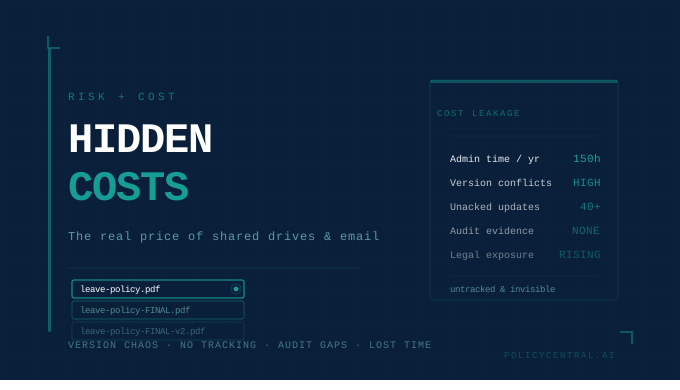
When multiple versions of a policy exist across drives, inboxes, and desktops, the cost is not just confusion. It is legal exposure.
If a manager acts on an outdated disciplinary procedure, and that procedure contradicts the current approved version, the company has a problem. Not a paperwork problem. A litigation problem. Employment tribunals and labour commissioners do not accept “we thought that was the current version” as a defence.
The effort required to prove which version was active at a specific point in time, when that version was communicated, and who acknowledged it, is enormous when your records live in a shared drive. If you are using compliance tracking and reporting that logs acknowledgements with timestamps, you can answer those questions in minutes. Without it, you are digging through email threads from 18 months ago.
Email Chains Are Not a Distribution System
Sending a policy update over email feels like distribution. It is not.
Email is a broadcast. You have no way of knowing whether the attachment was opened, whether the right version was forwarded onward by managers, or whether it reached every employee who needed it. Worse, email creates a parallel archive of policies. People save attachments locally. They forward threads to personal inboxes. Six months later, someone is making decisions based on a PDF they saved to their Downloads folder in March.
Targeted policy distribution that pushes updates to specific roles, departments, or locations and then tracks who has read and acknowledged them is a fundamentally different thing from sending an email blast and hoping for the best.
The Time Cost Is Invisible Until It Is Not
Think about how much time your HR team spends on policy logistics. Searching for the right document. Responding to “which version is this?” messages. Chasing acknowledgements. Reformatting a policy for the third time because the original is buried in a folder nobody can find.
None of this shows up as a line item. It is absorbed into the general chaos of the week. But when you add it up across a team, it is significant. One mid-sized company estimated their HR team spent over three hours a week just managing document access and version-related queries. That is 150 hours a year. Not on strategy. On admin.
Compliance Gaps You Do Not Know Exist
The most dangerous compliance gap is the one you are not tracking. You updated your grievance redressal policy. You sent the email. You assume everyone knows.
But what about the 12 people who joined after that email went out? What about the three offices where the local HR contact was on leave that week? What about the employees who do not use company email as their primary communication channel?
Without systematic tracking, you do not know what you do not know. You find out during an audit, or worse, during a dispute.
The Organisational Trust Angle
There is a dimension to this that gets less attention than compliance: what poor policy management does to employee trust.
Policies, simplified with AI-powered automation
Book a 20-minute demo to see how PolicyCentral.ai streamlines policy creation, distribution, and compliance across your enterprise.
Book a DemoWhen employees cannot find the current version of a policy, or when they receive conflicting information from their manager and the drive, or when they discover mid-grievance that the procedure they followed was outdated, it damages their confidence in HR. It signals disorganisation. It makes people feel like the rules are unclear by design.
Conversely, when employees can look up a policy, interact with it, ask a question, and get a clear answer about what is current and what it means, they feel like they are being treated like adults. Employee interaction with policies matters not just for compliance, but for culture.
Where AI Changes the Calculus
The reason most companies have not solved this is that the manual solution is genuinely hard. Keeping a policy library current, ensuring distribution is tracked, flagging when policies are due for review, surfacing the right version at the right time: these are not simple tasks when done by hand.
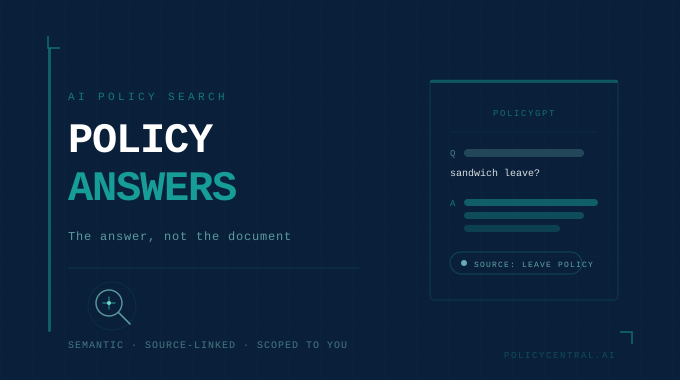
This is where AI-powered policy intelligence becomes relevant. Not AI as a buzzword, but AI that can flag when a policy has not been reviewed in 18 months, suggest updates based on regulatory changes, answer employee questions accurately by referencing the current approved version, and surface gaps in your policy framework before an audit does.
The difference between a shared drive and an intelligent policy management system is not just organisation. It is the difference between passive storage and active governance.
Scaling Makes Everything Worse
If this sounds manageable at 50 employees, imagine it at 500 or 5,000. Every version control problem multiplies. Every distribution gap affects more people. Every unacknowledged policy update is a larger liability.
Enterprise-grade policy management is not just about handling volume. It is about maintaining accuracy and accountability at scale, where the informal fixes that work for a small team simply do not hold up.
A Practical Way to Think About This
Here is a simple test. Pick any three HR policies in your organisation. Now answer the following without looking anything up:
-
When was each policy last updated?
-
Who approved the current version?
-
What percentage of relevant employees have acknowledged it?
-
How would you prove that acknowledgement if asked in a legal proceeding?
If any of these take more than two minutes to answer, or if the answers involve phrases like “I think it is in the drive” or “someone sent an email,” you have a policy management problem.
The shared drive is not the enemy. But treating it as a compliance infrastructure is the mistake.
Frequently Asked Questions
Is this really a legal risk, or is it more of an operational annoyance?
It is both, and the two are connected. Operationally, version confusion and poor distribution waste significant HR time. Legally, if a policy-related dispute goes to tribunal or mediation, your ability to demonstrate that the right policy was communicated, that the employee acknowledged it, and that the version enforced was the current approved version becomes critically important. Shared drives and email chains make this very hard to prove.
We are a small company. Does this apply to us?
Yes, though the urgency scales with size. Small companies have fewer resources to spend on admin overhead, which makes efficient systems more valuable, not less. A small HR team that spends hours each week on policy logistics is a team that is not doing strategic work. And compliance obligations like POSH, labour law requirements, and data protection policies apply regardless of company size.
What is the difference between a policy management system and just organising our Google Drive better?
A well-organised drive is better than a chaotic one, but it still cannot track acknowledgements, enforce version control, flag policies due for review, target distribution by role or location, or provide an auditable record of who was notified of what and when. These are governance functions, not filing functions. A policy management system is built for governance.
How long does it typically take to migrate from a shared drive setup to a dedicated system?
This depends on how many policies you have and how well-organised your current files are. For most organisations, the initial migration of core policies can be completed in a few weeks. The bigger time investment is in reviewing and updating policies that have not been touched in years, which is a process that reveals its own value quickly.
What if employees do not engage with a new system?
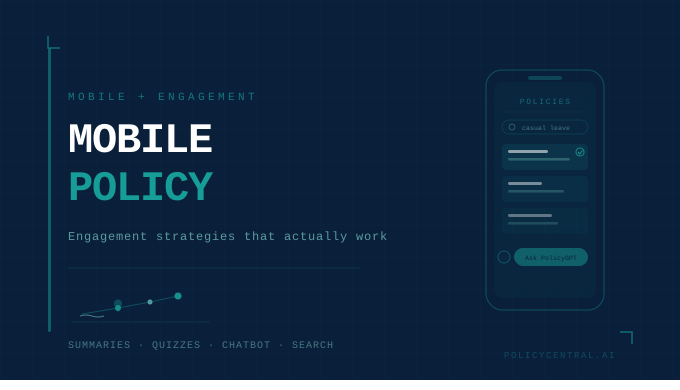
This is a real concern, and the answer usually lies in the employee experience. If employees can easily find policies, ask questions, and receive clear answers, engagement tends to be high. Systems that feel clunky or require multiple logins get ignored. The goal is to make compliance the path of least resistance, not an additional burden.