There is a policy document somewhere in your organisation that is out of date. You probably know this. You just do not know which one, or how out of date it is, or how many employees have already acted on the wrong version.
This is not a criticism. It is the default state of HR policy management at most companies, because the way policies have always been created and maintained was never really designed to keep up. A lawyer or senior HR professional drafts a policy, it gets approved, it gets uploaded somewhere, and then life moves on. The law changes, the company changes, the workforce changes. The document mostly does not.
AI is changing this. Not in a vague, futuristic sense, but in specific, operational ways that are already affecting how HR teams work today.
Why the Old Way Was Always Fragile
The traditional policy workflow looks like this: someone identifies a need (usually after an incident or an audit), a draft is written (usually in Word), it goes through a review loop (usually over email), it gets approved (usually by someone who is very busy), and it gets filed somewhere (usually a SharePoint folder that is not well-organised).
Then, somewhere between six and eighteen months later, a law changes, or a court ruling shifts interpretation, or the company expands to a new geography, and nobody updates the document because nobody has a system that tells them to.
The fragility here is not about effort or intention. HR teams work hard. The fragility is structural. Document-based policy management does not have any feedback loops. It has no way to surface when content is stale, no mechanism to detect when a regulatory change makes a clause incorrect, and no way to verify whether employees have actually read or understood what they signed off on.
The result is what you see in most organisations: policies that are technically current in the document management system but functionally outdated in practice.
What AI Actually Does in a Policy Workflow
When people talk about AI in HR policy, they sometimes mean a chatbot that answers employee questions. That is one application, and a useful one. But the more significant changes are happening earlier in the workflow, at the drafting and maintenance stage.
Gap detection during drafting. AI systems can compare a draft policy against a regulatory framework and flag what is missing. If you are writing a grievance redressal policy and it does not include a timeline for acknowledgement that the applicable law requires, an AI-assisted drafting tool surfaces that gap before the document is published. A human reviewer might catch it too, but a human reviewer is also juggling seventeen other things and working from memory about what the statute says.
Regulatory change monitoring. This is where the maintenance problem gets genuinely solved. An AI system that is connected to regulatory sources can monitor for changes in legislation, gazette notifications, or tribunal decisions and alert you when an existing policy is affected. That alert might say something like: “The amended Prevention of Sexual Harassment guidelines issued in 2023 affect Section 4 of your POSH policy. Review recommended.” A human team running an annual review cycle would catch this eventually. An automated system catches it immediately.
Consistency checking across the policy library. Large organisations accumulate hundreds of policies over time. Individual policies may be internally consistent, but contradict each other in practice. Your leave policy might describe a different escalation process than your grievance policy. Your code of conduct might use different definitions of “misconduct” than your disciplinary action policy. AI tools can cross-reference the entire policy library and surface these inconsistencies at scale, which is work that no human team has the bandwidth to do manually with any regularity.
AI-powered policy intelligence built into a policy platform takes this a step further, because the intelligence is not sitting in a separate tool. It is embedded in the same workflow where policies are created and updated. The gap between identifying an issue and fixing it collapses.
The Version Control Problem Is More Serious Than It Looks
Most HR teams would tell you they have version control under control. They have a naming convention. They have a shared folder. They have a designated person who is supposed to manage updates.
Policies, simplified with AI-powered automation
Book a 20-minute demo to see how PolicyCentral.ai streamlines policy creation, distribution, and compliance across your enterprise.
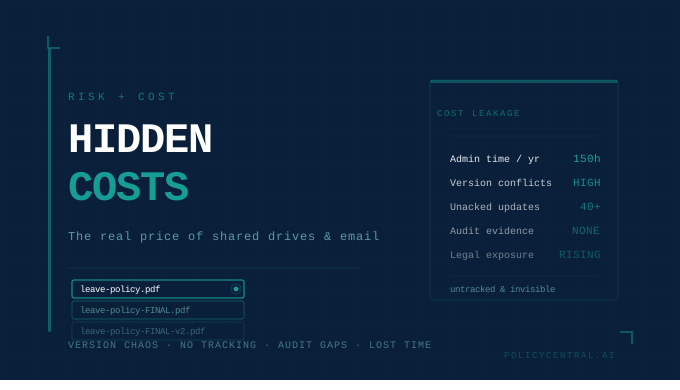
Book a DemoWhat they usually have, in practice, is multiple versions of the same document floating across different systems. A version that employees see on the intranet. A version in the legal team’s folder. A version someone downloaded six months ago and emailed to a new manager. A version that was updated after an audit and re-uploaded without archiving the old one properly.
When an employee raises a grievance, or when a labour inspector asks to see your current policies, which version is definitive? If your answer involves any amount of checking and cross-referencing, your version control is not actually under control.
Compliance tracking and reporting tools address this by creating a single, timestamped record of what each policy says at any point in time, who approved what, when changes were made, and which version was in force during any given period. That is not just good practice. In a dispute or an audit, it is the difference between being able to demonstrate compliance and not.
Policy Distribution: The Gap Between Published and Read
A policy that is published but not read is legally and operationally somewhere between useless and dangerous. Legally, there are certain communications (harassment policies, data handling policies, code of conduct) where you need to demonstrate that employees were informed. Operationally, a policy that nobody knows about does not change behaviour.
Traditional distribution looks like this: the policy is uploaded, a mass email is sent, employees are asked to acknowledge receipt, some do and some do not, HR chases the ones who did not, gets about 70% compliance, and the rest sits in a follow-up pile indefinitely.
AI-assisted distribution changes the targeting logic. Instead of broadcasting to everyone, policies go to relevant employees based on role, location, employment type, or lifecycle event. A new joiner in a client-facing role in Maharashtra gets the customer data policy, the anti-bribery policy, and the POSH policy in their onboarding flow, along with confirmation tracking. A manager who gets promoted to a new band receives the updated delegation of authority policy automatically. An employee who changes their working arrangement to a contract structure gets the relevant variation to their terms.
This is what distribution and targeting capability actually looks like in practice. It is not email blasts. It is contextual delivery tied to the right moment in the employee lifecycle.
Multi-Entity and Multi-Geography Complexity
For a 50-person company in one city, policy management is manageable with good discipline and a decent folder structure. For a 5,000-person company operating across multiple states, or a group with several legal entities under a common holding structure, manual policy management at scale becomes genuinely untenable.
Each entity may have different regulatory obligations. The creche obligation under the Maternity Benefit Act kicks in at 50 employees, which means a subsidiary with 45 people has different requirements than the parent with 300. Karnataka and Maharashtra may have different Shops and Establishment Act requirements that affect leave policies. A company expanding into a union territory faces different labour law structures than it did in the states where it started.
Managing all of this without a system means either over-engineering a single policy that tries to cover everything (which becomes unwieldy and confusing), or maintaining separate documents per entity (which creates a maintenance burden that nobody has the capacity to handle sustainably).
Enterprise policy infrastructure solves this through structured policy variants: a common framework with controlled, entity-specific or geography-specific overrides. The base policy is maintained centrally. The variations are managed as documented deviations with their own approval and review workflows. When the base changes, the system flags which variants need to be reviewed for impact.
The Employee Side of the Equation
Policy management conversations tend to focus on the employer side: drafting, compliance, risk. But there is an employee experience dimension that matters just as much, and that AI is also reshaping.
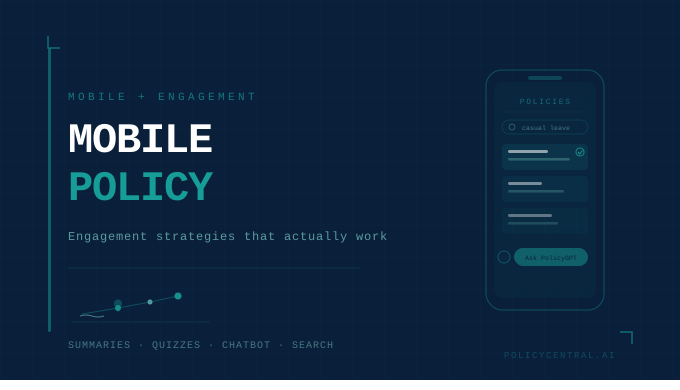
Most employees do not read the policy handbook. This is not apathy. It is a rational response to documents that are long, written in legal language, not searchable, and sitting in a location that takes four clicks to reach. When an employee has a question about their notice period or their entitlement to emergency leave, they ask their manager. The manager may or may not know the answer. The answer they give may or may not match what the policy actually says.
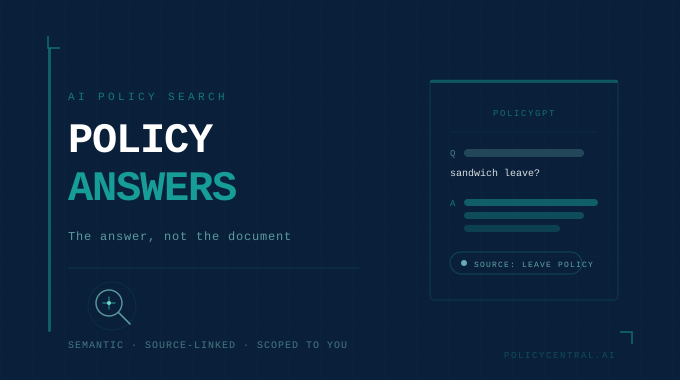
A system that allows employees to interact directly with policy content through natural language, get the relevant clause surfaced in plain English, and confirm they are reading the current version closes that gap. The employee gets a reliable answer. The manager is not put in the position of being an unreliable policy interpreter. And the organisation has a record that the question was asked and the correct information was provided.
This matters particularly in high-stakes policy areas: harassment, grievance redressal, medical leave, disciplinary processes. These are exactly the areas where employees most need accurate information and where incorrect information creates the most legal exposure.
What AI Does Not Replace
Useful to say clearly: AI does not replace employment lawyers, experienced HR professionals, or the judgment that comes from understanding the specific context of an organisation and its people.
What AI replaces is the manual, low-judgment work that currently consumes a disproportionate share of HR bandwidth. Checking whether a policy matches a statutory requirement is not a task that requires strategic thinking. Monitoring whether a gazette notification affects an existing document is not a task that benefits from human intuition. Tracking which employees have acknowledged which version of which policy is not a task that human teams do reliably at scale.
When AI handles those tasks, HR professionals get to spend more time on the work that actually requires their expertise: advising managers on difficult people situations, thinking through how policy changes affect culture, building the frameworks that shape employee experience. That is a better use of their capability than maintaining a spreadsheet of policy acknowledgements.
What Good Looks Like
The best-run policy operations share a few characteristics. Policies are reviewed on a defined cycle and also triggered for review when relevant regulatory changes occur. There is a single definitive version of each policy and a clear audit trail of changes. Employees receive relevant policies at the right moment in their lifecycle, not in a bulk upload during onboarding. Employees can find and understand policy content without needing to ask HR. And the HR team has visibility into which policies are due for review, which have low acknowledgement rates, and which are generating the most employee questions.
None of that requires AI in principle. All of it is dramatically easier with AI in practice.
The organisations building that kind of policy infrastructure now are not doing it because it is fashionable. They are doing it because the alternative, managing compliance complexity manually at the pace regulation is changing, is increasingly untenable.
Frequently Asked Questions
Does AI actually understand employment law well enough to be trusted in a policy workflow?
AI tools in policy platforms are not making legal determinations. They are pattern-matching against a defined regulatory corpus, flagging potential gaps or mismatches, and escalating them for human review. The human review step remains essential. What AI does is ensure that gaps get surfaced consistently, not only when a human reviewer happens to remember to check.
Can AI help write policies from scratch, or only review existing ones?
Both. AI-assisted drafting tools can generate a first draft based on a policy brief, applicable regulatory framework, and organisational parameters. That first draft still needs expert review and customisation. But getting to a 70% draft in hours rather than a blank page at the start of a week changes the economics of policy creation meaningfully.
How does AI handle policy topics where the law is ambiguous or frequently litigated?
Carefully, and with flagging. Good AI systems are calibrated to highlight areas of legal uncertainty rather than resolve them. If a clause touches a statutory provision that has been interpreted inconsistently across tribunals, the system should surface that uncertainty rather than present a single answer as definitive.
What about policies that are industry-specific or highly organisation-specific?
AI tools can be trained on or configured with industry-specific regulatory frameworks. Generic AI will not know the specific requirements of, say, a registered NBFC or a Category 1 stockbroker without that configuration. Policy platforms built for regulated industries typically handle this through curated regulatory libraries rather than general-purpose AI.
Does automating policy distribution create legal risk if something goes wrong with the targeting?
The targeting logic needs to be auditable and the system needs to maintain records of what was sent to whom and when. If a policy is incorrectly distributed or missed for a specific employee due to a data error, the audit trail allows you to identify and correct the gap. That is significantly better than a manual process where there is no audit trail and errors are invisible until they surface in a dispute.
Is employee data safe in AI-driven policy platforms?
This depends entirely on the platform and its architecture. Reputable policy management platforms are built with data residency, access controls, and audit logging as baseline requirements. For regulated industries or companies handling sensitive employee data, the platform should be able to demonstrate compliance with applicable data protection requirements, including the DPDP Act in India.
How long does it typically take to migrate a policy library to an AI-assisted platform?
It varies with the size and condition of the existing library. A well-organised library of 50 policies can often be migrated and configured in a few weeks. A large, fragmented library across multiple entities with inconsistent formatting and unclear version histories takes longer, partly because the migration process itself surfaces how many underlying problems need to be resolved first.