Compliance has a manual labor problem. According to Hyperproof’s 2025 IT Risk and Compliance Benchmark Report, 52% of compliance professionals spend 30 to 50% of their time on administrative tasks like manual data entry. Not analysis. Not risk judgment. Data entry.
Meanwhile, 65% of risk and compliance professionals say automation is the most effective way to cut the complexity and cost of compliance. Yet most organizations are still chasing acknowledgments by email, running policy reviews from spreadsheets, and piecing together audit evidence from three or more disconnected systems.
The consequences are predictable. Organizations managing risk reactively experience a 60% data breach rate, compared to 41% for those using integrated, automated tools. The average regulatory violation now costs $2.3 million when fines, remediation, and reputational damage are included. Non-compliance factors push the average cost of a data breach to $4.61 million.
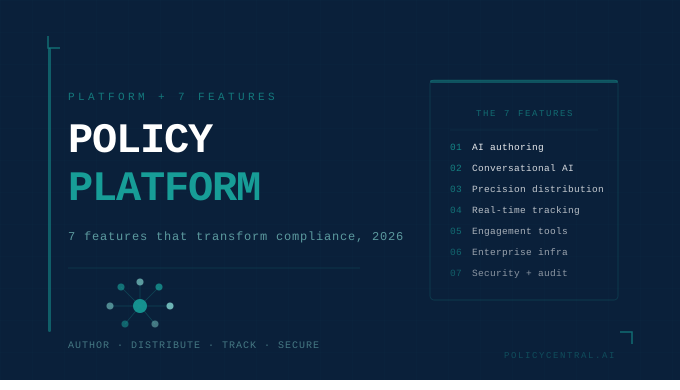
Here are the seven features that make the difference between a policy repository and a compliance engine.
Feature 1: AI-Powered Policy Authoring and Simplification
Most policies are written by legal or compliance teams for legal and compliance audiences. Then they are distributed to 5,000 employees who process expenses, serve customers, or manage field operations.
The mismatch between the writing audience and the reading audience is one of the most underappreciated drivers of compliance failure.
A mid-sized company with 300 employees and 20 core policies faces 6,000 potential acknowledgment points. If half of those policies are updated annually, that is 3,000 new sign-offs to chase.
But the more important problem is not the chasing. It is that many of those employees will click acknowledge without genuinely understanding what changed, because the language is written for lawyers and the format assumes desktop reading with unlimited time.
AI-powered authoring tools address this at the source. Readability scoring flags clauses that are likely to generate confusion before a policy is published. Automated simplification suggests plain-language rewrites of dense regulatory language. Summary generation produces a two-paragraph version of a 40-page policy that an employee can read in 90 seconds and actually retain.
The AI intelligence features that matter here go further still: automatic FAQ generation from policy content, infographic and flowchart creation from complex process descriptions, and quiz generation for comprehension verification. These are not cosmetic improvements to the presentation. They are the infrastructure of genuine understanding, which is the only form of compliance that holds up under scrutiny.
Feature 2: Conversational AI Access for Employees
The most common compliance failure mode is not an employee who knew the rule and ignored it. It is an employee who was not sure what the rule said, could not find the answer quickly, made a judgment call, and got it wrong.
PolicyGPT-style conversational AI changes this dynamic completely. An employee can ask, in plain language, how many casual leaves they can carry forward, whether they need to declare a vendor gift over a certain value, or what the escalation process is for a suspected data breach. The chatbot retrieves the answer from the organization’s own published policies and responds with a cited reference, not a generic internet answer.
The compliance benefit is direct: every interaction represents an employee actively seeking to act correctly, and every response is sourced from the authoritative policy document.
The interaction log also creates useful signal for compliance officers. Questions that recur frequently indicate either ambiguous policy language or a process that employees are finding difficult to navigate in practice. Both are audit risks you would rather identify through search analytics than through a regulatory finding.
The evidence picture improves too. An AI chat log showing that an employee asked the right question before taking a consequential action is a materially stronger compliance record than a bulk acknowledgment timestamp from six months ago.
Feature 3: Precision Distribution with HRMS and Active Directory Sync
A policy sent to the wrong audience is noise. Noise trains employees to ignore notifications. An organization that sends every policy to every employee as a matter of routine will eventually train its workforce to treat all policy communications as low-priority events, including the critical ones.
Policies, simplified with AI-powered automation
Book a 20-minute demo to see how PolicyCentral.ai streamlines policy creation, distribution, and compliance across your enterprise.
Book a DemoPrecision distribution solves this, but only if it is automated. Manual audience management is accurate on day one and drifts continuously as people join, leave, transfer departments, and change roles. The resulting acknowledgment records reflect the organizational chart as it was when someone last updated the distribution list, not as it is.
The distribution and targeting capability that syncs directly with your HRMS and Active Directory eliminates this drift at the source. Target by department, location, grade, role, and employment type. When an employee transfers from the Chennai operations team to the Mumbai credit team, their policy profile updates automatically. When a new joiner arrives, relevant policies are delivered on day one without anyone needing to remember to send them.
Evergreen mode extends this further: configure the target profile for a policy once, and every future joiner matching that profile receives it automatically. The onboarding compliance gap that most organizations only discover during an audit closes before it opens. Getting this distribution layer right is the backbone of any enterprise policy workflow automation effort.
European businesses that automate their compliance distribution processes reduce operational costs by 42 to 68% depending on sector, with a median payback period of seven months, according to a LexisNexis Risk Solutions study from 2025. Precision distribution is a large part of where those savings come from.
Feature 4: Real-Time Tracking and Compliance Reporting
The question most compliance teams can answer today is: who has not acknowledged this policy? It is a useful question, but it is not sufficient.
The more important questions are harder. Which policies have high acknowledgment rates but low read-time, suggesting employees are clicking through without reading? Which departments are consistently lagging across multiple policy types? Which policies are generating search queries that never result in a document being opened, suggesting the policy either does not exist or cannot be found?
Organizations that used security AI and automation extensively reported $1.9 million lower data breach costs and time savings of 80 days identifying and containing breaches compared to organizations that did not. The mechanism behind that finding is partly the speed of detection and partly the availability of clean, current evidence when an incident is investigated.
The tracking and reporting capability that makes this possible goes beyond acknowledgment dashboards. It includes read-time analytics, search behavior analysis, department-level compliance rates, policy expiry alerts, and historical trend data showing whether your compliance posture is improving or degrading over time.
Search analytics deserve particular attention. If 200 employees searched “conflict of interest” last quarter and most left without opening a document, your policy library has a gap that is generating behavioral risk right now, and you can see it before it becomes a finding.
Feature 5: Intelligent Employee Engagement Tools
There is a specific problem with compliance-only thinking about policy management: it optimizes for the acknowledgment record rather than the underlying behavior.
The goal of a policy is not to generate a signed timestamp. It is to produce an employee population that acts in accordance with the organization’s obligations.
Engagement infrastructure bridges this gap. Modern compliance tools allow organizations to proactively monitor key compliance indicators, forecast risk trends, and test controls in real time. At the policy layer, this means capturing genuine employee engagement rather than just mechanical acknowledgment.
The employee interaction features that drive real engagement include: e-signatures that create legally defensible acknowledgment records; inline comment threads where employees can flag confusing language before it generates a compliance failure in the field; response buttons that capture structured employee feedback on policy clarity; and AI-generated comprehension quizzes that verify understanding rather than just receipt.
The engagement data from these features is as valuable as the acknowledgment record itself. An organization that can demonstrate to a regulator not just that a policy was distributed, but that 89% of employees passed a comprehension quiz and that the 11% who did not were followed up with targeted training, has a compliance narrative that a click-to-acknowledge system simply cannot support.
Feature 6: Enterprise-Grade Infrastructure and White-Label Deployment
Adoption is the prerequisite for everything else. A compliance platform that employees treat as a third-party tool they access under duress once a year is not a compliance platform. It is a liability with a nicer UI than a shared drive.
The infrastructure factors that determine adoption in large enterprises are unglamorous but decisive. Single sign-on eliminates the login friction that turns a 30-second policy read into a three-minute process of recovering forgotten credentials. Active Directory sync means the platform always reflects the current workforce, not a snapshot from the last bulk import. A white-label mobile app published under the company’s own brand in the iOS and Android stores is treated as infrastructure by employees, not as optional software from a vendor they have never heard of.
The enterprise features that support large-scale deployment also include multi-department architecture, allowing different business units to manage their own policy libraries while maintaining a unified compliance record; API access for custom integrations with existing GRC, HRIS, and communication tools; and flexible deployment options including on-premise hosting for organizations with data residency requirements.
For BFSI organizations in particular, the ability to publish a branded mobile app and deliver policies as a native experience, rather than through a browser-based portal, is the difference between a compliance tool that gets used and one that exists on paper.
Large enterprises deploying integrated compliance tools can expect to cut administrative time by 50 to 70% through workflow automation, according to 2026 contract management benchmarks. The underlying driver is the same across categories: when compliance infrastructure integrates seamlessly with the workflows employees already use, the friction cost of compliance drops to near zero.
Feature 7: Security, Audit Trail Integrity, and Compliance of the Platform Itself
There is an irony that sophisticated compliance teams have to navigate: the platform they use to document compliance must itself be compliant.
An acknowledgment record stored in a system that lacks immutable audit logs, granular access controls, or encryption at rest is an acknowledgment record that will not hold up under forensic examination.
Companies using integrated and automated GRC tools are far less likely to experience data breaches at 41%, compared to those managing risk reactively at 60%. The security posture of the platform is not separable from the compliance value it provides.
The security and compliance infrastructure of a genuine policy intelligence platform includes AES-256 encryption for data at rest and in transit, VAPT-tested architecture, granular role-based access controls, IP restriction capabilities, and tamper-evident audit logs that capture every action taken on every policy document, including who created, modified, approved, distributed, and acknowledged it, with timestamps that cannot be edited after the fact.
For regulated industries, particularly banking and insurance, this is not a feature checklist item. It is the difference between a compliance record that withstands a regulatory examination and one that creates additional exposure. India’s DPDP Act, RBI outsourcing directions, and SEBI’s CSCRF all contain explicit expectations about the security architecture of systems handling compliance-relevant data. A platform that cannot demonstrate its own security posture creates a compliance gap at the exact point where you are trying to document compliance.
The combination of immutable audit trails, encrypted storage, and VAPT certification means the evidence you collect is itself credible evidence. That distinction matters most precisely when you need it most: during an investigation, an audit, or litigation.
What Separates a Policy Repository From a Policy Intelligence Platform
The distinction is worth stating plainly, because the market is full of tools that use intelligence language while delivering repository functionality.
A repository stores documents and tracks who clicked a button. A policy intelligence platform actively reduces compliance risk: it helps employees understand policies, surfaces gaps before regulators find them, delivers the right policy to the right person automatically, and maintains the kind of documented engagement record that holds up when tested. The mechanics of how that gap detection works are covered in our companion piece on how AI detects compliance gaps before audits.
The transition from periodic audits to continuous compliance monitoring represents a fundamental shift in how organizations manage regulatory risk and operational efficiency, with three-year ROI exceeding 285% in all enterprise size scenarios analyzed in 2026.
The seven features above are what that shift looks like at the policy management layer. Individually, each one improves a specific part of the compliance workflow. Together, they close the gap between a policy library that exists and a compliance program that actually works.
If you want to see how PolicyCentral.ai brings all seven of these capabilities together in a single platform, request a demo today.
Frequently Asked Questions
What is a policy intelligence platform?
It is a compliance management system that uses AI to do more than store and distribute policies. A policy intelligence platform actively monitors compliance gaps, analyzes employee engagement, simplifies policy content, and maintains real-time audit-ready evidence, as distinct from a document repository that requires manual oversight of all these functions.
How does PolicyGPT improve compliance outcomes?
By giving employees a conversational interface to ask questions about policies in natural language, PolicyGPT reduces the most common compliance failure mode: acting on a misunderstanding because finding the correct answer was too difficult. Every chatbot interaction is also logged, creating a record of active engagement that supports a stronger compliance narrative than acknowledgment alone.
What is Evergreen mode in policy distribution?
It is a setting that automatically delivers a policy to any new employee who matches the configured target criteria when they join the organization, without requiring manual action. It eliminates the onboarding compliance gap that causes organizations to discover coverage failures during audits rather than before them.
How important is HRMS sync for policy distribution accuracy?
Critical. Without HRMS sync, distribution lists drift the moment anyone joins, leaves, transfers, or changes role. The acknowledgment records you collect reflect the organizational chart as it was when the list was last manually updated, which is typically months out of date. Live HRMS sync ensures your compliance evidence reflects the actual workforce at all times.
Why does the security architecture of the platform itself matter for compliance?
Because the acknowledgment records and audit logs you collect are only as credible as the system that stores them. If a regulator or court questions whether records could have been altered, a platform with immutable, encrypted, VAPT-tested audit infrastructure has a demonstrably defensible answer. A platform running on a shared drive or a generic cloud storage layer does not.
What ROI can organizations expect from a policy intelligence platform?
Research published in 2026 shows three-year ROI exceeding 285% across enterprise sizes when comparing continuous compliance monitoring to periodic manual audits. Specific drivers include 50 to 70% reductions in administrative time, 12,500 to 20,000 saved analysis hours in large healthcare deployments, and a 41% versus 60% breach rate difference between automated and reactive compliance management.
Is a policy intelligence platform suitable for organizations already using a GRC tool?
Yes, and typically they are complementary. GRC platforms manage controls and risk registers. Policy intelligence platforms manage the employee-facing layer: how policies are written, understood, distributed, and acknowledged. Many organizations use both, with the policy platform feeding acknowledgment and engagement data into the broader GRC evidence picture via API.