The policy management software market is growing fast. According to Research and Markets, it reached $1.87 billion in 2025 and is on track for $2.19 billion in 2026, a compound growth rate of roughly 19% that carries it past $6.4 billion by 2032. The reason is not fashion. It is pressure.
The PwC Global Compliance Survey found that 85% of governance leaders believe compliance requirements have grown more complex over the past three years. Cube’s 2025 Cost of Compliance report found that 60% of compliance professionals expect that cost to keep rising. And 68% of large enterprises now run dedicated policy management software rather than managing policies from shared drives and email.
So the question is no longer whether to buy a platform. It is which one, and how to judge it. This guide is written for that decision, from the perspective of an Indian enterprise that has to satisfy the RBI, SEBI, IRDAI, and the DPDP Act at the same time.
Why the best global tool is rarely the best Indian tool
Most published rankings of policy management software are written for a North American or European buyer. They optimize for HIPAA, SOX, and GDPR, and they assume the workforce reads English on a desktop.
An Indian enterprise operates in a different reality. Your policies may need to reach a field workforce across a dozen states in the language they actually read. Your regulator may expect proof of workforce-wide engagement, not just a signed acknowledgment. And your data residency obligations under the DPDP Act and sector rules may rule out a platform that only offers hosting in a foreign region.
That is why a tool that tops a global list can still be the wrong choice here. The evaluation criteria that matter for India are different, and they are the ones a generic ranking tends to skip. Here is the checklist that actually separates contenders.
The criteria that separate contenders
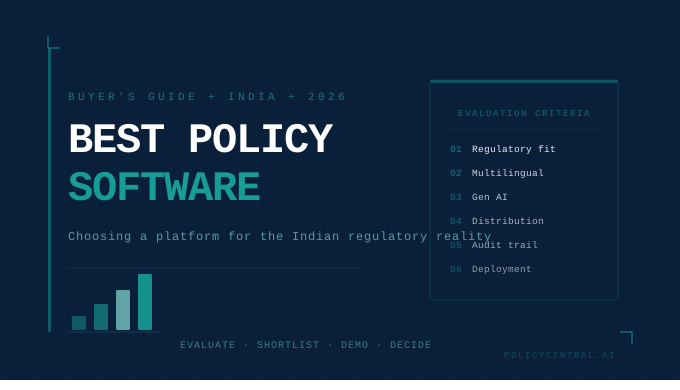
Regulatory fit for Indian frameworks. This is the first filter and the one most global tools fail. Ask whether the platform understands the specific expectations of the RBI’s outsourcing directions, SEBI’s cyber resilience framework, IRDAI’s governance expectations for insurers, and the DPDP Act. A platform built for these frameworks maps policies to obligations. A platform retrofitted for them stores documents and leaves the mapping to you.
Multilingual delivery. A policy an employee cannot read is not a control. It is a liability with a timestamp. If any part of your workforce reads Hindi, Tamil, Bengali, or Marathi more comfortably than English, the platform has to deliver and track acknowledgment in those languages natively, not through a copy-paste translation workflow. We cover why this has become a compliance necessity, not a nicety, in our guide to multilingual HR policies.
Gen AI that does real work. The market has shifted from repositories to AI-native platforms, and the gap between them is now the main thing a buyer is choosing between. The features that matter are the ones that reduce compliance risk: plain-language simplification of dense policy text, automatic FAQ generation, and a conversational assistant that lets an employee ask a question and get an answer cited from your own policy, not a generic web result. Our companion piece on the seven features that define a policy intelligence platform breaks down what to look for here.
Precision distribution with HRMS sync. A policy sent to the wrong audience is noise, and noise trains people to ignore the notifications that matter. The platform should target by department, location, grade, role, and employment type, and it should sync live with your HRMS and Active Directory so distribution lists do not drift every time someone joins, leaves, or transfers. This is the backbone of any serious policy workflow automation effort.
Audit-trail integrity. The records you collect are only as credible as the system that stores them. Look for immutable, tamper-evident logs, encryption at rest and in transit, and role-based access controls. When a regulator questions whether an acknowledgment record could have been altered after the fact, the platform’s own security architecture is what answers the question.
Analytics beyond acknowledgment. Most tools can tell you who has not acknowledged a policy. The better question is which policies have high acknowledgment but low read-time, which departments lag across policy types, and which searches never lead to a document being opened. Our breakdown of the policy KPIs every compliance officer tracks covers the numbers that belong on that dashboard.
Deployment and data residency: the BFSI dealbreaker
For banks, NBFCs, and insurers, deployment is not a technical footnote. It is a regulatory constraint.
Policies, simplified with AI-powered automation
Book a 20-minute demo to see how PolicyCentral.ai streamlines policy creation, distribution, and compliance across your enterprise.
Book a DemoA pure multi-tenant SaaS product hosted only in a foreign region can be a non-starter for an institution with data residency obligations. The platforms that win in Indian BFSI offer a spectrum: standard SaaS for organizations that want speed, hybrid deployment where sensitive content sits in the customer’s own storage, and full on-premise or private-cloud hosting for institutions that need the data to never leave their control.
If your shortlist includes a tool that offers only one deployment model, confirm early that the model is one your compliance function can actually sign off on. It is a cheaper question to ask in week one than in month three.
How to run the evaluation without wasting a quarter
The mistake most teams make is booking eight demos and comparing them on whatever each vendor chose to show. A structured evaluation avoids that.
Start by writing down your non-negotiables: the regulatory frameworks you answer to, the languages your workforce reads, and the deployment model your data residency rules allow. Use that list to cut a long list of eight or ten tools down to a shortlist of three before you sit through a single demo.
Then run each shortlisted tool against a real scenario rather than a feature checklist. Take one genuinely complex policy, define the actual audience it needs to reach, and ask each vendor to show you the full journey: authoring, targeted distribution, acknowledgment in more than one language, and the audit report you would hand a regulator. The tool that handles your hardest real case well is a safer bet than the tool with the longest feature list.
Finally, weight the criteria to your situation. A retail chain with a large frontline workforce should weight multilingual delivery and mobile experience heavily. A mid-sized NBFC should weight regulatory mapping and audit-trail integrity. There is no single ranking that is correct for every buyer, which is exactly why a criteria-first approach beats a borrowed top-ten list.
Where PolicyCentral.ai fits
PolicyCentral.ai was built for the Indian regulatory reality rather than adapted to it. It delivers and tracks policies across ten Indian languages, maps policy obligations to the frameworks Indian enterprises answer to, and offers SaaS and hybrid deployment so that data residency is a configuration choice rather than a blocker.
Its Gen AI layer, PolicyGPT, lets employees ask policy questions in plain language and get answers cited from the organization’s own published policies, while the analytics layer tracks genuine engagement rather than mechanical sign-off. For a direct feature comparison against two established global tools, our PowerDMS vs PolicyCentral vs ConvergePoint breakdown puts the differences side by side.
The right way to test any of this is against your own hardest policy, not a demo script. If you want to run that test with PolicyCentral.ai, request a demo and bring your most complex, multi-audience policy with you.
Frequently Asked Questions
What is policy management software?
It is a platform that handles the full lifecycle of workplace policies: authoring, review, targeted distribution, employee acknowledgment, and audit reporting. Modern platforms add AI-driven authoring and search, and replace the manual work of chasing sign-offs across email and shared drives with automated, trackable workflows.
What should Indian companies look for that global buyers do not?
Three things global rankings tend to skip: regulatory fit for RBI, SEBI, IRDAI, and DPDP obligations; multilingual delivery and acknowledgment in Indian languages; and deployment options that satisfy data residency rules, including hybrid and on-premise hosting. A tool can top a global list and still fail all three.
Is cloud or on-premise better for policy management?
For most organizations cloud is faster to deploy and easier to maintain, which is why the majority of buyers choose it. For regulated BFSI institutions with data residency obligations, hybrid or on-premise hosting may be required so that sensitive policy data never leaves the organization’s control. The best platforms offer all three so the choice is yours.
How important is AI in a policy management platform in 2026?
It has moved from a differentiator to a baseline expectation. The market has shifted from document repositories to AI-native platforms that draft and simplify policy text, generate FAQs, and answer employee questions conversationally with citations from your own policies. A platform without meaningful AI is now a repository, not a policy intelligence platform.
How long should a policy management software evaluation take?
A disciplined evaluation takes weeks, not a quarter. Cut a long list to three tools using your non-negotiable criteria before booking demos, then test each shortlisted tool against one genuinely complex real policy rather than a feature checklist. The tool that handles your hardest real case well is the safer choice.
Does PolicyCentral.ai support Indian languages and data residency requirements?
Yes. PolicyCentral.ai delivers and tracks policies across ten Indian languages and offers SaaS and hybrid deployment, so organizations with data residency obligations can keep sensitive policy data within their own environment while still using the full platform.