Here is a number worth sitting with: only 21% of employees globally are engaged at work, according to Gallup’s 2026 State of the Global Workplace report. In the US it sits at 31%, an 11-year low.
Now think about the last time your organization sent a policy update. Did employees read it? Did they understand it? Or did they tap “acknowledge” in under four seconds because the notification arrived at 5:47 PM on a Friday and they just wanted to clear it?
Mobile-first policy management is one of the cleaner fixes to this problem. Not because it makes policies prettier, but because it meets employees where they already are: on their phones, during natural gaps in their day, rather than tethered to a desktop they may not even have.
Here is what actually works.
Why Mobile Changes the Policy Equation
Over 80% of the global workforce is deskless. Field teams, frontline workers, branch staff, delivery personnel: these are not people sitting in front of a company laptop at 9 AM waiting for a policy email to arrive.
Research published in 2026 found that 83% of frontline workers lack regular access to email, meaning traditional policy distribution, the kind that relies on an inbox and a desktop, is effectively invisible to a large chunk of most organizations. You can have the best-written code of conduct in the industry and it simply never reaches the people it is meant for.
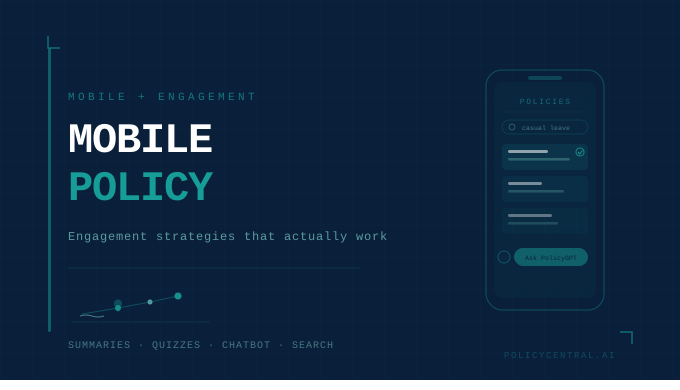
A mobile policy management app does not solve bad policy writing. But it removes the distribution and access barrier entirely. Employees open the app between calls, during a commute, over lunch. The policy is there, formatted for a phone screen, searchable, and not buried under 200 other unread emails.
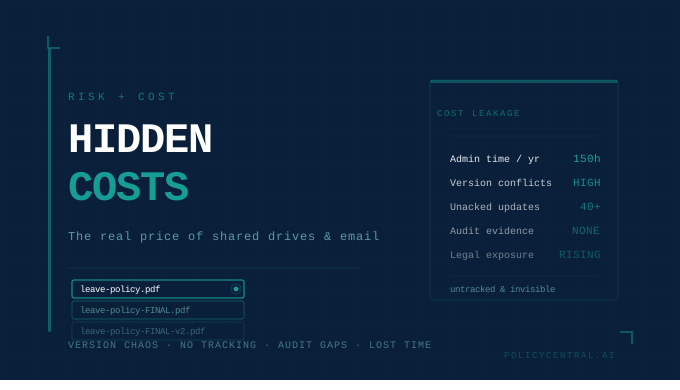
That is a sharp contrast with the failure mode we describe in the hidden cost of managing HR policies in shared drives and email chains. That access shift matters enormously when you are trying to move engagement from passive to active.
Strategy 1: Stop Sending Walls of Text
The biggest engagement killer in policy management is not laziness. It is cognitive overload.
A 40-page HR policy manual is not a communication tool. It is a filing cabinet. Employees do not engage with filing cabinets; they just note their existence.
The fix is not to summarize policies yourself and hope for the best. AI-powered tools can now auto-generate concise summaries from full policy documents, pulling out the key obligations and entitlements in plain language. The AI intelligence features in platforms like PolicyCentral.ai go further, converting complex policy sections into visual infographics and flowcharts automatically, and generating FAQ sets directly from the document content. This is part of a broader shift in how AI is changing the way companies draft and maintain HR policies.
When an employee can open a policy on their phone and see a clean summary, a visual of the key process, and a short FAQ answering the three questions most people actually ask, engagement goes up. Not because you forced it. Because you made engagement the path of least resistance.
Strategy 2: Get the Right Policy to the Right Person
A policy about parental leave sent to a 22-year-old contractor, or a cybersecurity policy pushed to the facilities team, is noise. Noise trains people to ignore notifications. That is the opposite of what you want.
Policies, simplified with AI-powered automation
Book a 20-minute demo to see how PolicyCentral.ai streamlines policy creation, distribution, and compliance across your enterprise.
Book a DemoPrecision targeting is one of the highest-leverage moves in policy engagement, and it is almost entirely overlooked by organizations still running distribution through email blasts and shared drives.
Effective distribution and targeting means segmenting your audience by department, location, role, grade, and seniority, and syncing that segmentation automatically with your HRMS or Active Directory so it stays current without manual maintenance. When a new joiner joins the Mumbai credit team, they should receive the credit policy automatically, on day one, without anyone having to remember to send it.
Evergreen distribution, where new employees matching a target profile automatically receive relevant policies on joining, is the kind of feature that looks simple and has an outsized effect on compliance gaps. Most organizations discover their onboarding policy coverage holes only during an audit. This closes them before they open.
Strategy 3: Make Engagement a Two-Way Street
Most policy tools are broadcast tools. The organization pushes a document. The employee is expected to receive it, read it, and confirm they read it. That is the end of the interaction.
That model made sense when policies were printed and filed. In 2026, it is a missed opportunity.
Employees who can ask questions, leave comments, or flag confusing clauses on a policy are more engaged with that policy. They are also giving you useful signal about which sections need clearer language before someone acts on a misunderstanding in a high-stakes situation.
Meaningful employee interaction features on a mobile platform include inline comments, response buttons, comprehension quizzes generated from the document, and even emoji reactions. The last one sounds trivial. It is not. Reaction data tells you whether employees found a policy clear, confusing, or frustrating, without requiring a formal survey. That is free insight that most compliance teams would pay for.
E-signatures matter here too, particularly for policies where acknowledgment carries legal weight. A mobile-native e-signature flow that takes 15 seconds gets done. A flow that requires opening a desktop browser, logging into a separate system, and locating the right document gets deferred indefinitely.
Strategy 4: Use Data to Find the Gaps Before Regulators Do
Compliance reporting in most organizations answers one question: who has not acknowledged this policy? That is useful but incomplete.
The more interesting questions are: which policies have low read-through rates despite high acknowledgment? Which departments consistently lag? Which search terms are employees typing into the policy library, suggesting they cannot find what they need?
Real-time tracking and reporting gives compliance and HR teams a live view of engagement, not just a snapshot of who clicked a button. When you can see that 74% of the IT department has acknowledged your data security policy but the average time spent reading it was 11 seconds, you have a problem that a re-send will not fix.
Search analytics in particular are underused. If 200 employees searched for “overtime pay” in the past 30 days and most of them left without opening a document, either the policy is missing or it is buried under a name no one would think to search. That is an engagement failure you can actually fix.
Strategy 5: Make the App Feel Like Yours
Adoption is the prerequisite for engagement. And adoption has a lot to do with trust and familiarity.
An app that looks like a third-party tool, carries a generic brand, and sits separately from everything else employees use will be treated as optional. An app published under your company name, with your brand, in your app store, as part of your onboarding flow, is treated as infrastructure.
The enterprise features that matter most for adoption are not the flashy ones. They are the quiet ones: white-label mobile apps published under your brand on iOS and Android, SSO so employees do not need a separate login, Active Directory sync so the employee roster is always current, and a Google-style search experience across all policy content including Word, PDF, and Excel attachments.
When an employee can open your company’s app, search for “casual leave”, and get an accurate answer in under 10 seconds, that is an engagement outcome. They used the tool, found what they needed, and left with more clarity than before. That is what policy management is actually for.
Strategy 6: Build for Comprehension, Not Just Completion
The compliance function tends to care about completion rates. Legal cares about having a signed acknowledgment on file. Both are valid concerns.
But neither of them answers the question that actually matters in a crisis: did the employee understand what they were agreeing to?
Comprehension-oriented features are where mobile policy management gets genuinely interesting. Auto-generated quizzes from policy content test understanding, not just attention. A PolicyGPT-style chatbot lets employees ask natural language questions and receive answers sourced directly from the relevant policy, rather than guessing or asking a manager who might not know either.
These tools close the gap between a policy being received and a policy being internalized. That gap is where most compliance failures actually live.
Security and compliance infrastructure underpins all of it. Audit logs, IP restrictions, AES-256 encryption, and role-based access controls ensure that the engagement data you are collecting, and the policies themselves, are handled with the rigor that regulated industries require.
What Good Policy Engagement Actually Looks Like
Good policy engagement looks like: employees who can describe what your code of conduct actually requires, a frontline team that knows how to report an incident without having to call HR, a branch manager who can look up the answer to a policy question in 30 seconds without escalating.
Mobile makes that possible in a way that desktop-first, email-distributed, PDF-heavy policy management never could. The phone is already in the employee’s pocket. The question is whether your policy infrastructure meets them there or makes them go somewhere else.
The organizations getting this right are not doing anything complicated. They are targeting precisely, writing accessibly, making interaction easy, and measuring the right things. The technology handles the rest.
If you want to see how PolicyCentral.ai delivers policies through a white-label mobile app with AI summaries, comprehension quizzes, and real-time engagement analytics, request a demo today.
Frequently Asked Questions
What is a mobile policy management app?
It is a mobile application, usually available for iOS and Android, that gives employees access to your organization’s policies, procedures, and compliance documents. Good ones include search, acknowledgment tracking, e-signatures, and AI-powered features like chatbots and summaries.
Why is mobile delivery better than email for policy distribution?
Because most of the workforce, especially frontline and field employees, does not engage reliably with email. Mobile apps deliver policies in a format employees already use, with push notifications, search, and a reading experience designed for a phone screen rather than retrofitted from desktop.
How do you measure policy engagement versus just acknowledgment?
Track read time alongside acknowledgment, monitor search behavior to see what employees are looking for, use comprehension quizzes, and analyze which policies have low open rates relative to their importance. Platforms with search analytics give you signal that a binary acknowledged or not-acknowledged report never will.
Does a white-label mobile app really make a difference for adoption?
Yes. Employees trust and use apps that feel like part of their company’s ecosystem. An app published under your brand, available through your enterprise app store, and accessible via your existing SSO removes every adoption friction point. Generic-branded third-party apps get treated as optional tools and frequently go unused.
How does AI actually help with policy engagement on mobile?
The most impactful uses are: summarizing long documents into readable highlights, generating FAQs from policy content, powering a chatbot that answers employee questions in natural language, and creating visual infographics from complex process descriptions. Together these reduce the effort required to understand a policy, which directly increases how many people actually engage with it.
What engagement features should HR teams prioritize first?
Start with precision targeting so you are only sending relevant policies to relevant people. Then add AI summaries to make content digestible. Then layer in comprehension checks, quizzes or chatbot access, so you can measure actual understanding. Acknowledgment tracking and reporting complete the loop.
Is mobile policy management suitable for large enterprises with complex org structures?
Specifically yes. Large organizations with multiple departments, locations, grades, and roles benefit most from HRMS and AD-synced targeting and evergreen distribution. The complexity that makes email-based distribution unmanageable is exactly what mobile policy platforms with automated audience management are built to handle.