Nobody should have to write a Code of Conduct or an Information Security Policy from a blank page. A good template gives you the structure, the standard clauses and the language, so your team can spend its time on the part that actually matters: making the policy fit your organization and your regulator.
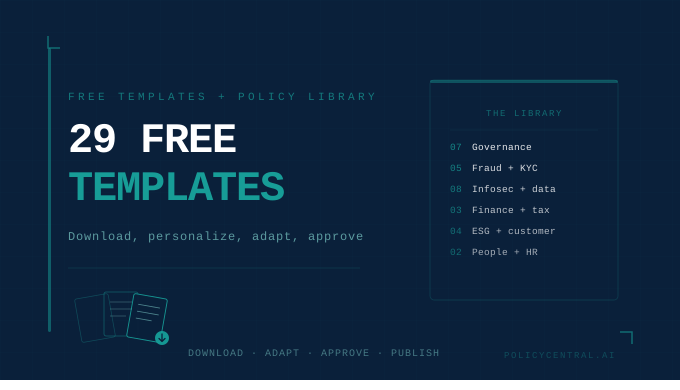
That is why we built a free library of 29 policy templates for Indian companies, organized into 6 categories covering governance, fraud and KYC, information security, finance and tax, ESG and customer, and HR. Each one can be read in full on the site and downloaded as a PDF personalized with your company name.
This guide explains what is in the library, which templates map to which regulatory obligations, and how to turn a template into a policy that will stand up in an audit.
What is in the policy template library
Templates in the PolicyCentral.ai policy library follow a consistent structure: objectives, scope and applicability, the policy statement, roles and responsibilities, review and employee acknowledgment, plus a set of frequently asked questions. Each page lists the key sections the policy covers, so you can see at a glance whether it fits your need before you download.
Governance and Ethics (7 templates)
- Code of Conduct and Ethics Policy
- Anti-Bribery and Anti-Corruption (ABAC) Policy
- Whistleblower and Ethics Policy
- Conflict of Interest Policy
- Gifts and Entertainment Policy
- Vendor and Third-Party Compliance Policy
- Corporate Governance and Compliance Oversight Policy
Fraud Risk and KYC/AML (5 templates)
- KYC and Customer Due Diligence (CDD) Policy
- Anti-Money Laundering (AML) Policy
- Counter-Terrorist Financing (CTF) Policy
- Sanctions Screening and Compliance Policy
- Fraud Risk Management Policy
Information Security and Data (8 templates)
- Data Privacy Policy
- Information Security Policy
- Cybersecurity Policy
- Access Control Policy
- Password and Authentication Policy
- Data Retention and Disposal Policy
- Remote Work and Device Use Policy
- Email and Communication Security Policy
Finance, Tax and Reporting (3 templates)
ESG, DEI and Customer (4 templates)
- Corporate Social Responsibility (CSR) Policy
- Environmental, Social and Governance (ESG) Policy
- Customer Complaint Redressal and Grievance Handling Policy
- Diversity, Equity and Inclusion (DEI) Policy
People and HR (2 templates)
More HR templates are on the way. For the HR policies Indian companies are expected to have, see our list of HR policies every Indian company should have.
How to download a personalized copy
Every template can be read in full on its page, free and without signing up. If you want a copy to work from, open the template, enter your name, your work email and your company name, and we will email you a PDF with your company name already filled in throughout the document. It takes under a minute, and the PDF is ready to share with your legal, compliance or HR team as a first draft.
Which templates map to which regulations
A template is most useful when you know which obligation it is meant to satisfy. Here is how the library lines up with three of the most common regulatory drivers for Indian companies.
Policies, simplified with AI-powered automation
Book a 20-minute demo to see how PolicyCentral.ai streamlines policy creation, distribution, and compliance across your enterprise.
Book a DemoDPDP Act and Rules
The Digital Personal Data Protection Rules, 2025 bring most obligations into force in May 2027. Start with the Data Privacy Policy, Data Retention and Disposal Policy, Information Security Policy and Access Control Policy. Our guide to the policies every company must update for the DPDP Rules explains exactly what each needs to contain.
SEBI Listing Regulations and the Companies Act
Listed companies must maintain a code of conduct, a whistleblower mechanism and a CSR policy, among others. The Code of Conduct, Whistleblower, Conflict of Interest, CSR and Corporate Governance templates are the natural starting points. See our full checklist of mandatory policies for listed companies.
RBI Directions for NBFCs and banks
Regulated lenders need board-approved KYC, AML, fraud risk, grievance redressal, outsourcing and business continuity policies. The KYC and CDD, AML, Fraud Risk Management, Customer Complaint Redressal, Vendor and Third-Party and BCDR templates cover this ground. Our NBFC board-approved policy checklist maps each one to the current RBI Direction.
How to turn a template into a policy that holds up
Downloading a template takes a minute. Turning it into a policy that works takes a clear process. These are the steps we recommend.
- Identify the obligation. Name the law, regulation or Direction the policy responds to, and note its current version date.
- Close the gaps. Compare the template against the specific requirements of that source. Add any mandatory elements, thresholds or timelines the template does not include.
- Make it yours. Replace generic roles with your actual job titles, committees and reporting lines. A policy that says “the Compliance Officer” when you have no such role will not survive an audit.
- Assign an owner. Every policy needs one named person accountable for keeping it current.
- Route it for approval. Many policies must be approved by the board or a board committee. Record who approved which version, and when.
- Distribute and collect acknowledgment. Send the approved version to everyone it applies to, in a language they read, and keep a record that they received and understood it.
- Schedule the review. Set a review date based on the regulatory cycle, and revisit sooner if the underlying rule changes.
Our guide on how to write a policy document goes deeper on structure and drafting, and our explainer on policy lifecycle management covers the full journey from draft to acknowledgment.
What a template cannot do
A template solves the first problem: getting the words on the page. It does not solve the problems that come after. It will not tell you when a regulation changes. It will not route the draft through approval, track which version is current, put the policy in front of every employee it applies to, or prove later that they read it.
Those are the problems that usually surface during an audit or an inspection, and they are the reason so many companies outgrow shared drives and SharePoint as their policy system.
How PolicyCentral.ai takes a template further
PolicyCentral.ai is the platform behind this library. It takes a policy from draft through review and approval, publishes the approved version to exactly the audience it applies to, delivers it in ten Indian languages, and tracks acknowledgment with a tamper-evident audit trail. It reminds owners when reviews are due and keeps every past version on record.
Employees can also ask questions about any policy in plain language and get an answer grounded in the current approved text. You can try that yourself in our PolicyGPT live demo, which searches a library of 65 sample policies. When you are ready to run your own policies this way, request a demo.
Frequently Asked Questions
Are the PolicyCentral.ai policy templates free?
Yes. All 29 templates can be read in full on the website at no cost. To receive a PDF copy personalized with your company name, you enter your name, work email and company name on the template page, and the PDF is emailed to you.
Which policy templates are available?
The library has 29 templates across six categories: Governance and Ethics, Fraud Risk and KYC/AML, Information Security and Data, Finance, Tax and Reporting, ESG, DEI and Customer, and People and HR. They include a Code of Conduct, Whistleblower, Anti-Bribery, KYC and CDD, Anti-Money Laundering, Fraud Risk Management, Data Privacy, Information Security, Cybersecurity, CSR, ESG and Business Continuity policy, among others.
Can I use these templates for DPDP compliance?
They are a useful starting point. The Data Privacy, Data Retention and Disposal, Information Security and Access Control templates cover the policy areas the DPDP Rules touch, but each must be adapted to the specific requirements of the Rules, such as the notice content, 72-hour breach reporting to the Board and one-year log retention, and reviewed before approval.
Are these templates legally compliant as they are?
No template is compliant on its own. These are sample documents to be adapted to your organization, your sector and the current text of the regulations that apply to you. They are not legal advice, and should be reviewed by your legal or compliance team before approval.
How often should a policy be reviewed after it is adopted?
At least as often as the governing regulation requires, and whenever that regulation changes. For example, SEBI requires listed companies to review their related party transactions policy at least once every three years, and RBI requires Middle and Upper Layer NBFCs to review their compliance policy at least once a year.
How is PolicyCentral.ai different from a template library?
A template gives you the text of a policy. PolicyCentral.ai manages everything after that: approval workflows, version control, distribution to the right audience in ten Indian languages, acknowledgment tracking with an audit trail, review reminders, and an AI assistant that answers employee questions from the current policy.