There is a version of policy acknowledgment that most organizations still rely on: send a PDF, collect a click, file the record. It looks like compliance.
In many cases it satisfies the bare minimum of a legal requirement. But in 2026, the regulatory bar for what counts as adequate acknowledgment documentation has moved considerably, and the gap between “we sent it” and “we can prove they understood it” is where enforcement actions, civil litigation, and audit failures are increasingly concentrating.
This is not an abstract concern. Breaches involving a noncompliance factor cost an average of $4.61 million in 2025, and only 29% of organizations say their compliance programs consistently meet internal and external standards, according to research covering 500 enterprise decision-makers.
Here is what the law actually requires, industry by industry, and what good acknowledgment infrastructure looks like in practice.
Why Acknowledgment Records Are Under More Scrutiny Than Ever
The trend across virtually every regulated sector is the same: regulators are moving from “did you have a policy” to “can you prove it was understood and acted upon.” The difference matters enormously in an investigation.
Regulators now demand demonstrable governance: documented evidence that you have robust systems, controls, and processes in place, and that they are actually working.
A policy buried in a shared drive with no distribution record fails this standard. An email blast with no read confirmation is marginally better. A timestamped, individually tracked, version-specific acknowledgment with a comprehension check attached is what regulators are increasingly expecting to see.
Fragmented tools and manual processes remain the dominant failure mode: 92% of organizations rely on three or more tools to gather audit evidence, and only 39% of the audit evidence process is automated.
When an auditor asks for proof that a specific employee acknowledged the updated data security policy from nine months ago, finding that confirmation across three systems and two email archives is not just inconvenient. It is a compliance failure waiting to happen. This is the same fragmentation problem we cover in the hidden cost of managing HR policies in shared drives and email chains.
Banking and Financial Services (BFSI)
For banks, NBFCs, insurance companies, and capital market intermediaries, policy acknowledgment sits at the intersection of multiple overlapping regulatory frameworks, each with its own record-keeping expectations.
India: RBI, SEBI, and IRDAI
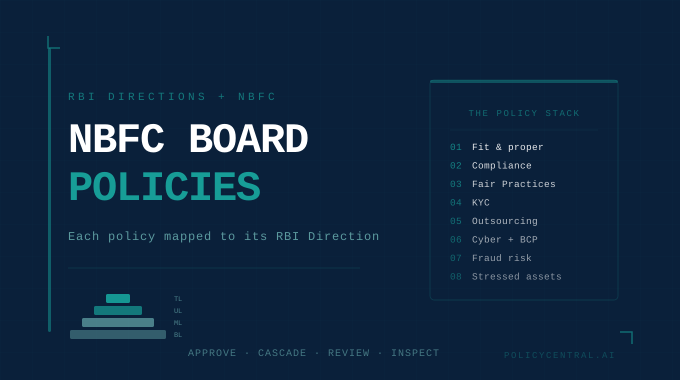
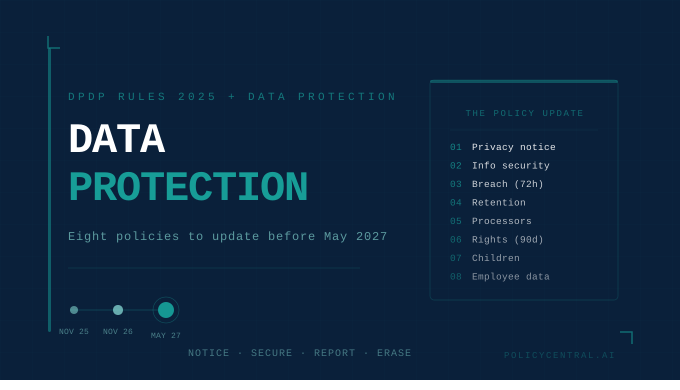
In India, the regulatory landscape for financial institutions is dense. The DPDPA, along with RBI guidelines on outsourcing and SEBI’s Cybersecurity and Cyber Resilience Framework, require financial institutions to structure their compliance operations around data security protocols, including encryption, and to maintain comprehensive audit trails.
Under the Digital Lending Directions 2025, financial entities must ensure that any data collected through their Digital Lending Apps is strictly need-based and obtained with explicit consent, supported by a clear audit trail. This consent and acknowledgment infrastructure is not optional; it is a regulatory expectation that covers employee-facing internal policies as well as customer-facing disclosures.
For SEBI-regulated entities, the record-retention obligations are particularly stringent. Market intermediaries, stock exchanges, and depositories are required to maintain secure and auditable IT systems and retain investor records for prescribed periods.
Internally, this obligation extends to the policies governing how those systems are operated and who has been trained and acknowledged on their correct use. IRDAI requirements in the insurance sector add another layer: insurers are required to maintain detailed records relating to policies and claims and must ensure robust safeguards when outsourcing data processing activities. For a deeper look at the Indian financial sector, see our guide to HR policy compliance for Indian banks and NBFCs.
The practical implication for Indian BFSI organizations is that employee policy acknowledgments need to be stored with the same rigor as customer consent records: timestamped, version-specific, individually attributed, and accessible for examination within hours, not days.
United States: SOX, FINRA, and Gramm-Leach-Bliley
US financial institutions operate under a combination of federal and state obligations. SOX Section 302 requires senior executives to personally certify that internal controls are operating effectively, which cannot be done credibly without documented evidence that employees across the organization have acknowledged and been trained on the relevant control policies.
FINRA-regulated firms face specific documentation requirements around written supervisory procedures. Acknowledgment that registered personnel have read and understood these procedures must be documented and available on request during examination.
Several states exempt financial entities subject to the Gramm-Leach-Bliley Act in their entirety from certain data privacy obligations, while others exempt only the GLBA-covered data, leaving the institution within scope for non-GLBA data. This creates a multi-jurisdiction compliance obligation that means acknowledgment records for data handling policies may need to satisfy more than one standard simultaneously.
Healthcare
Healthcare is one of the most demanding environments for policy acknowledgment tracking, combining federal baseline requirements with state-level additions and the constant threat of OCR investigation.
Policies, simplified with AI-powered automation
Book a 20-minute demo to see how PolicyCentral.ai streamlines policy creation, distribution, and compliance across your enterprise.
Book a DemoHIPAA
HIPAA compliance records must be retained for a minimum of six years from the date on which the record was last in effect. If a policy created in 2019 is still in force, the acknowledgment record must be retained for at least six years from the date that policy is no longer in force.
This means acknowledgment records are not an administrative byproduct of policy management; they are themselves regulated documents with defined retention periods.
An organization that purges acknowledgment records on a three-year cycle while operating policies that have been active since 2018 is creating a compliance gap even if the underlying policy is perfectly written.
The OCR’s audit program, active through 2025 and beyond, specifically examines whether covered entities and business associates can produce evidence of workforce training and policy acknowledgment on demand. The 130 million breach notification letters sent in connection with the Change Healthcare incident alone demonstrate what an inadequate documentation posture costs when regulators start examining it.
For healthcare organizations, the acknowledgment infrastructure needs to capture not just “acknowledged” but who, which version, when, through what delivery mechanism, and whether any comprehension verification was completed. That complete record is what withstands an OCR investigation.
Technology and Data-Intensive Industries
GDPR and EU Data Protection
Total GDPR fines reached approximately €5.65 billion by March 2025, with multiple fines in the €250 to €345 million range issued to major companies in 2024.
The policies that attract enforcement attention most frequently are those governing data subject rights, data breach response, and lawful basis for processing, all of which require employees across multiple departments to understand and follow specific procedures.
GDPR does not specify a precise acknowledgment format, but the accountability principle (Article 5(2)) requires organizations to demonstrate compliance, not merely assert it. In practice, supervisory authorities have treated the absence of documented employee training and acknowledgment as an aggravating factor in enforcement decisions.
EU AI Act (Full Enforcement from August 2026)
High-risk AI obligations become fully enforceable by August 2026. High-risk AI systems may require approximately 95% documentation and audit readiness.
For organizations deploying AI in employment decisions, credit scoring, or customer profiling, this includes documented evidence that personnel operating or overseeing these systems have been trained and have acknowledged their obligations under the Act.
Only 23% of organizations feel confident in their AI governance frameworks, which suggests the acknowledgment infrastructure for AI-specific policies is significantly underdeveloped relative to where enforcement expectations now sit.
Employment Law: Across Industries
Employment-related policy acknowledgment requirements are among the most jurisdiction-specific and frequently updated obligations any HR or legal team manages.
California leads the list of states with mandatory written policies covering sexual harassment prevention, paid sick leave, wage theft protection, lactation accommodations, and specific meal and rest break rules. New York requires written sexual harassment policies with annual training acknowledgment and specific complaint procedures.
Some states specify the exact language that must appear in acknowledgment forms. Organizations operating in multiple states must track which states require which policies, and even a single employee in California means that employee must receive California-specific policies and acknowledgments.
The recommended acknowledgment language from a legal defense standpoint has become increasingly specific. Effective acknowledgment language should confirm that the employee received the handbook on a specific date, read and understood the policies, agrees to comply, and understands that the company may modify policies at any time.
A generic “I have read and understood the above” no longer provides adequate legal protection in high-liability states.
What Adequate Acknowledgment Infrastructure Looks Like in 2026
Given the requirements above, the characteristics of a legally defensible acknowledgment system are fairly clear.
Version specificity. The acknowledgment record must be tied to a specific version of a specific policy, with the date that version was in effect. “Acknowledged the data security policy” is not sufficient. “Acknowledged version 4.2 of the Data Security Policy dated March 14, 2026, at 11:42 AM” is the standard regulators expect.
Individual attribution. Each acknowledgment must be tied to an identified individual, verified through authentication, not just an email address that might be accessed by a shared inbox or an assistant.
Tamper-evident storage. The record must be immutable after creation. An audit log that can be edited, or an acknowledgment system running on a shared drive where files can be overwritten, fails the basic evidentiary standard.
Timely distribution and follow-up. Best practice includes individual acknowledgment forms collected within 30 days of distribution, with a follow-up reminder at 14 days for employees who have not signed. For high-risk policies, shorter windows are appropriate.
Comprehension verification. An acknowledgment without any comprehension check is increasingly thin protection. The employee interaction features that support quizzes, chatbot Q&A, and inline clarification requests create a documented record of genuine engagement, not just receipt.
Real-time reporting. The tracking and reporting capability that tells compliance officers who has not acknowledged a policy, which departments are lagging, and which policies are approaching their review date is not a convenience feature. In a regulated industry, it is the mechanism by which you close gaps before an auditor finds them. Our breakdown of the KPIs every compliance officer tracks covers exactly which numbers to watch.
Secure, auditable infrastructure. The security and compliance architecture of the platform itself matters: AES-256 encryption, granular audit logs, role-based access controls, and VAPT-tested infrastructure. If your acknowledgment records are held in a system that cannot demonstrate its own security posture, you have introduced a compliance risk at the point where you are trying to document compliance.
Targeting and Retention: The Two Overlooked Dimensions
Most organizations focus on collection: getting the acknowledgment signed. Two equally important dimensions get less attention.
The first is targeting precision. A policy sent to the wrong population generates acknowledgment records that are useless in an investigation and create false compliance confidence.
Distributing a policy via email attachment is not enough. The distribution and targeting capability that syncs with your HRMS and Active Directory to deliver the right policy to the right employee, automatically including new joiners who match the target profile, is what ensures your acknowledgment records actually reflect your workforce.
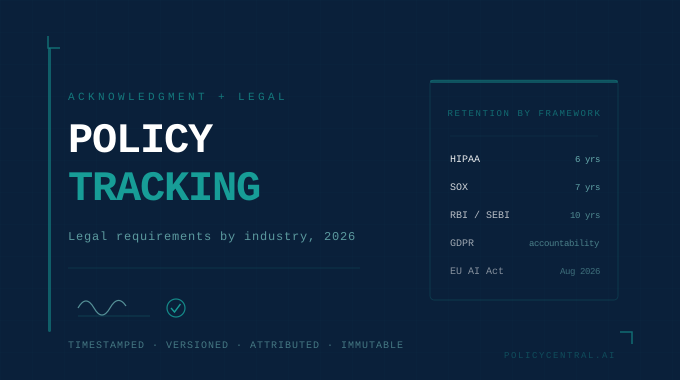
The second is retention management. Different regulatory frameworks have different retention periods, some as short as three years, others as long as seven or ten. HIPAA mandates six years from the date a record was last in effect, which for a long-running policy can extend the retention window considerably.
The enterprise features that support policy lifecycle management, expiry alerts, review scheduling, and archival workflows are what keep retention compliant without requiring manual tracking. The AI intelligence features that generate comprehension quizzes and FAQ sets from policy content close the final gap: an acknowledgment system that produces evidence of understanding, not just receipt.
The Bottom Line for Compliance Teams
The legal requirements around policy acknowledgment in 2026 are not going to simplify. Regulatory fragmentation across jurisdictions, the arrival of AI Act enforcement, the maturation of data protection enforcement across both the EU and India, and the ongoing expansion of state-level employment law obligations in the US are all moving in one direction.
The cost of building that infrastructure is a fraction of the cost of one enforcement action. The question is not whether it is worth building. It is whether you build it before or after you need it.
If you want to see how PolicyCentral.ai delivers timestamped, version-specific acknowledgment tracking with comprehension checks and audit-ready reporting across your entire workforce, request a demo today.
Frequently Asked Questions
Is a digital signature legally equivalent to a handwritten signature for policy acknowledgment?
In most jurisdictions, yes. E-signatures governed by frameworks such as the US ESIGN Act, India’s Information Technology Act, and the EU’s eIDAS Regulation are legally valid for employment policy acknowledgments. The key requirements are that the signature be attributable to a specific individual, created with that individual’s intent, and associated with an immutable record of the acknowledged document.
How long must policy acknowledgment records be retained?
It depends on the industry and jurisdiction. HIPAA requires six years from when a record was last in effect. SOX-relevant records typically require seven years. Indian financial institutions operating under RBI and SEBI frameworks have overlapping retention obligations that can extend to ten years for certain record types. Best practice is to apply the longest applicable retention period across all frameworks governing your organization, rather than managing separate schedules.
Does every policy update require a new acknowledgment?
It depends on the nature of the change. For regulated industries, any substantive change to a policy, meaning a change that affects employee obligations or rights, should trigger a new acknowledgment cycle. Minor formatting or editorial changes generally do not. Organizations should document their materiality threshold explicitly so the decision is consistent and defensible.
What happens if an employee refuses to acknowledge a policy?
An employee’s refusal to acknowledge does not invalidate the policy, but the refusal itself should be documented. Most employment law frameworks allow organizations to take disciplinary action for refusal to acknowledge mandatory policies, provided the policy was distributed through a reasonable channel, the employee had adequate opportunity to review it, and the requirement was clearly communicated. The documentation of refusal is as important as the documentation of acknowledgment.
Can acknowledgment records be stored in a general HR system like Workday or SAP?
They can be stored there, but most general HRIS platforms lack the version-control, audit trail integrity, and compliance reporting depth that regulated industries require. The risk is that a record stored in a system without immutable audit logs may not hold up under scrutiny. Dedicated policy management platforms with purpose-built acknowledgment tracking provide a more defensible record.
What is the difference between acknowledgment and attestation?
Acknowledgment typically means the employee confirms they received and read a policy. Attestation goes further: the employee affirms that they understand the policy and will comply with it. In high-stakes regulatory environments such as SOX certifications, HIPAA workforce training, and FINRA supervisory procedures, attestation is the expected standard, not just acknowledgment.
How should organizations handle policy acknowledgment for contractors and third-party staff?
This is a common gap. Contractors and third-party personnel who have access to regulated data or operate under regulated processes should receive relevant policy acknowledgments before commencing work. The acknowledgment record should identify their employment status clearly. For GDPR and HIPAA purposes in particular, the absence of documented acknowledgment for contractors handling protected data is treated as a material gap.