Most compliance failures do not announce themselves. They accumulate quietly, in the space between what your policies say, what your employees actually do, and what regulators now expect.
By the time an auditor walks in and starts asking questions, the gap has usually been there for months.
The traditional response to this problem is to schedule an annual policy review, spend three weeks pulling documents, and hope nothing material has drifted since the last time anyone looked. That approach made sense when regulations changed slowly and audits were infrequent. Neither of those things is true in 2026.
A majority of organizations now conduct four or more audits per year. Ninety-six percent say keeping up with the volume of regulation is genuinely challenging. And only 29% report that their compliance programs consistently meet internal and external standards, according to research from Swimlane covering 500 enterprise decision-makers.
That is not a fringe problem. It is the baseline state of most compliance functions right now. Corporate policy intelligence tools, specifically the AI-powered category, exist to close the gap between that baseline and where your program actually needs to be. Here is how they work and what to look for.
The Core Problem: Point-in-Time Audits vs. Continuous Reality
The audit model most organizations still rely on is fundamentally a snapshot. An auditor reviews your policies and controls as they exist on a specific day.
But your regulatory environment, your employee behavior, your policy library, and your operational processes are all changing continuously. The snapshot captures one moment. Everything in between is blind.
The Swimlane research found that 54% of organizations spend more than five hours every week on manual compliance tasks alone, and 62% say their evidence-gathering process is at least occasionally error-prone.
When you are manually consolidating spreadsheets, chasing acknowledgments across departments, and cross-referencing policy versions before an audit, you are not doing compliance work. You are doing administrative archaeology.
What AI Policy Intelligence Actually Does
The term gets used loosely, so it is worth being specific about the distinct capabilities that make AI genuinely useful in compliance, rather than just a relabeled search function.
Natural Language Processing for Gap Detection
Regulations and internal policies are both written in natural language. Neither follows a consistent schema. Manually mapping a new RBI circular to your existing credit policy, or checking whether your data handling procedures still align with updated GDPR guidance, requires someone to read both documents carefully and reason about what is missing.
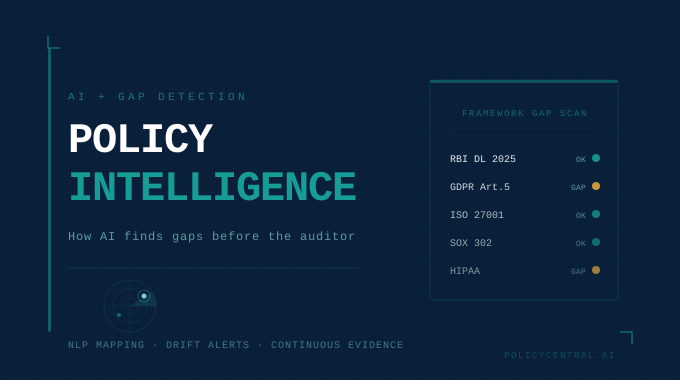
AI using natural language processing can do this at scale. It compares the language of your internal policy library against regulatory frameworks, identifies where your policies do not address a requirement, where the language is ambiguous enough to fail an audit interpretation, and where a single internal control could satisfy multiple regulatory obligations simultaneously.
IBM has reported that companies using AI for compliance see up to 30% cost savings in audit and regulatory review processes, largely because this mapping work no longer requires days of analyst time.
Predictive Gap Analysis
Historical compliance data has patterns. Certain departments consistently lag on acknowledgments. Certain policy types tend to drift from regulatory requirements over time. Certain employee populations are statistically more likely to act on a policy in ways that the policy itself did not anticipate.
AI systems trained on behavioral and operational data can surface these patterns before they become audit findings. Rather than discovering that your finance team has not acknowledged the updated conflict of interest policy for six months during a regulatory review, a predictive model flags it in week two of the drift and routes an automated alert to the relevant compliance officer.
This is the difference between a compliance function that is reactive and one that is genuinely proactive, not as a positioning statement, but as an operational reality.
Automated Evidence Collection and Audit Readiness
Ninety-two percent of organizations rely on three or more tools to gather audit evidence, and on average only 39% of the evidence collection process is automated, according to the same Swimlane research.
That means more than 60% of audit prep is still manual, still prone to version control errors, still dependent on the availability of specific people who know where things are stored.
AI-native compliance platforms connect directly to your policy management system, your HRMS, your communication logs, and your control frameworks. They maintain a continuously updated evidence package. When an auditor arrives, the question is not “where is everything” but “what specifically do you need.”
The ROI here is concrete. Continuous compliance monitoring has been shown to save large enterprises 12,500 to 20,000 analysis hours compared to periodic audit preparation cycles, according to 2026 data from Grant Thornton. Those are not hypothetical savings. They represent staff time redirected from evidence archaeology to actual risk management.
The Policy Layer: Where Most Organizations Have the Most Gaps
The compliance conversation often defaults to systems and controls. But the policy layer is where the foundation either holds or breaks.
Policies, simplified with AI-powered automation
Book a 20-minute demo to see how PolicyCentral.ai streamlines policy creation, distribution, and compliance across your enterprise.
Book a DemoA control can be technically implemented and still fail an audit if the underlying policy it is designed to enforce does not accurately reflect the current regulatory requirement. A policy can be perfectly written and still create compliance risk if employees cannot find it, do not understand it, or were never told it changed. This is why a real policy management system matters more than a shared folder of documents.
The AI intelligence features in modern policy management platforms address this directly. Auto-generated summaries make complex regulatory policy language accessible to the employees who need to act on it. AI-generated FAQs surface the most common misunderstandings before they become behavioral compliance gaps. Readability scoring and rewrite suggestions reduce the kind of ambiguous policy language that lawyers love and auditors flag.
On the distribution side, tracking and reporting provides the compliance team with real-time visibility into who has read what, when, and for how long, with search analytics showing what employees are looking for, often a reliable indicator of where the policies are unclear or missing.
Search data is underused here. If 300 employees searched “data retention” last quarter and most did not open a document, you have either a missing policy or a mislabeled one. That is an audit risk that shows up in your search logs months before it shows up on a regulatory finding.
Regulatory Mapping: One Policy, Multiple Frameworks
Large organizations typically operate across multiple regulatory frameworks simultaneously. A bank in India might need to satisfy RBI guidelines, IRDAI requirements, ISO 27001 controls, and internal board-approved policies, all of which overlap in some areas and conflict in others.
Manual cross-framework mapping is the kind of work that takes qualified compliance professionals weeks and produces results that are outdated the moment a regulation is amended.
AI handles this by mapping requirements at the clause level. Using NLP, it identifies where one internal policy satisfies multiple regulatory requirements, where a gap exists in the current library relative to one framework but not another, and where regulatory amendments require specific policy updates rather than a complete rewrite.
The practical output is a structured compliance register that is kept current automatically, rather than a spreadsheet that gets updated when someone finds the time.
The Employee Behavior Layer: Where Policy Meets Reality
A policy that exists but is not understood does not reduce compliance risk. It just provides documentation for a defense strategy after the fact.
AI closes the loop between policy distribution and behavioral compliance in two specific ways. First, comprehension measurement: quizzes generated from policy content, chatbot interaction logs showing what employees asked and whether they received accurate answers, and time-spent-reading data all provide signal about whether understanding actually occurred, not just acknowledgment.
The employee interaction features that support this, e-signatures, response buttons, inline comment threads, comprehension quizzes, and conversational AI access to policy content, create a documented record of engagement that holds up under scrutiny in a way that a bulk “acknowledged” timestamp does not.
Second, behavioral pattern analysis: when AI tools can analyze how employees are searching for, interacting with, and asking questions about policies, compliance officers get early warning about which policies are generating confusion or conflict. That signal is more valuable pre-audit than any questionnaire. The specific metrics worth watching are covered in our guide to the policy analytics KPIs every compliance officer tracks.
Security and Auditability of the Compliance Infrastructure Itself
There is an irony that many compliance teams navigate: the systems they use to manage compliance often cannot themselves withstand scrutiny. Evidence logs that can be edited, acknowledgment records without timestamps, policy version histories without proper controls.
Security and compliance infrastructure, AES-256 encryption, granular audit logs, IP restrictions, role-based access controls, and VAPT-tested architecture, is not a feature list for its own sake. It is what determines whether your compliance evidence is itself credible when presented to a regulator.
For BFSI organizations in particular, where the regulatory expectation is not just that you have policies but that you can demonstrate a continuous, unbroken chain of custody from policy creation through employee attestation to archival, the integrity of the underlying system matters as much as its features.
What to Look for in a Policy Intelligence Tool
Not every platform calling itself AI-native is equally capable. When evaluating tools, the distinctions that matter are these.
Continuous monitoring versus point-in-time scanning. A tool that runs a gap analysis on demand is useful. A tool that maintains a live compliance signal and alerts on drift is transformative.
NLP quality for your specific regulatory language. Generic models trained on English-language US regulations will perform differently on RBI circulars or IRDAI guidelines. Domain-specific training matters.
Integration depth. A compliance platform that cannot pull data from your HRMS, your Active Directory, your communication tools, and your document management system will create its own evidence gaps. The enterprise features that enable this, API access, AD sync, HRMS integration, are what determine whether the platform actually knows your organization or just processes documents in isolation.
Audit trail integrity. Every action in the platform should be logged, timestamped, and immutable. That log is your evidence.
Employee-facing accessibility. A tool that helps compliance officers find gaps is necessary. A tool that also helps employees understand and act on policies correctly is the one that actually reduces the gaps in the first place.
The distribution and targeting capability that ensures the right policy reaches the right employee at the right time, synchronized with your HRMS so new joiners are automatically included, is where the technical infrastructure of compliance meets the human behavior that compliance is ultimately trying to shape.
The Cost of Getting This Wrong
The financial case for proactive compliance is not subtle. Data breaches with a noncompliance factor cost an average of $4.61 million, according to 2025 IBM data. The average cost of a regulatory violation including fines, remediation, and reputational damage runs $2.3 million. The SEC ordered $8.2 billion in financial remedies in FY2024 alone.
Against those numbers, the cost of implementing AI-powered policy intelligence infrastructure is not a compliance line item. It is risk capital that returns multiples.
The organizations building that posture now are not doing it because an auditor asked them to. They are doing it because the gap between point-in-time compliance and continuous compliance intelligence is where most of the risk actually lives, and they would rather find it first.
If you want to see how PolicyCentral.ai detects policy gaps, maps your library across regulatory frameworks, and keeps a continuously audit-ready evidence package, request a demo today.
Frequently Asked Questions
What is corporate policy intelligence?
It refers to the use of AI and analytics to continuously monitor, analyze, and improve an organization’s policy library relative to regulatory requirements and employee behavior. Unlike traditional compliance management, which is audit-driven and periodic, policy intelligence works in real time, flagging gaps as they emerge rather than after they have become findings.
How does AI detect compliance gaps in policies?
Through natural language processing, AI compares the content of your internal policies against regulatory frameworks and identifies where requirements are unaddressed, ambiguously written, or outdated. It can also analyze employee behavior data, search patterns, and acknowledgment records to identify where the gap between policy and practice is widening.
How is this different from a traditional compliance gap analysis?
A traditional gap analysis is a project. Someone reviews your policies against a framework at a point in time and produces a report. AI-powered policy intelligence is continuous. The analysis is always running, and the output is a live compliance signal rather than a document that ages from the moment it is produced.
Which industries benefit most from AI compliance tools?
BFSI, healthcare, and any heavily regulated sector benefit most. Banking and insurance organizations face the highest audit frequency and the most complex multi-framework requirements, which is exactly where the ability to map policies across regulatory frameworks simultaneously delivers the most value.
Does AI replace compliance officers?
No. It removes the manual, repetitive work from their role: document collection, cross-referencing, version tracking, reminder management. What remains is judgment work: assessing materiality, making risk decisions, and managing regulator relationships. Most compliance professionals find this a significant improvement.
What data does an AI compliance tool need access to?
At minimum: your policy library, your employee directory, and your acknowledgment and training records. More advanced implementations also connect to your regulatory feed to detect changes automatically, your HR system to keep targeting current, and your document management system to catch policy-relevant content sitting outside the official library.
How quickly can organizations typically see results?
Baseline gap identification against existing frameworks can be completed in days rather than weeks once a platform has ingested your policy library. The ongoing value, continuous monitoring and predictive alerting, compounds over time as the system builds a behavioral baseline against which it can detect meaningful drift.