A policy that employees cannot understand is not a control. It is a liability with a signature attached. Yet most policy documents are written by legal or compliance teams, for legal and compliance audiences, and then handed to a workforce that has to actually follow them.
The PwC Global Compliance Survey found that 85% of governance leaders believe compliance requirements have grown more complex over the past three years. As the rules multiply, the quality of the underlying policy document matters more, not less. A well-written policy prevents confusion, defends you in an audit, and gives employees a clear answer when they need one. A badly written one generates risk quietly until something goes wrong.
This is a practical guide to writing a policy document that works: the structure to use, the process to follow, and the mistakes that turn a policy into a liability.
First, know what a policy is and is not
Before writing a word, be clear about what you are writing. A policy is a statement of intent and principle: it says what the organization requires and why. It is not a procedure, which is the step-by-step method for carrying the policy out, and it is not a process, which is the broader flow of activity across teams.
Blurring these three is the most common structural error in policy writing. A policy stuffed with procedural detail becomes obsolete the moment a tool or a form changes, and it has to go back through full approval every time. Keep the durable principle in the policy and push the changeable steps into a linked procedure. Our guide to the difference between a policy, a process, and a procedure covers this distinction in full.
The anatomy of a policy document
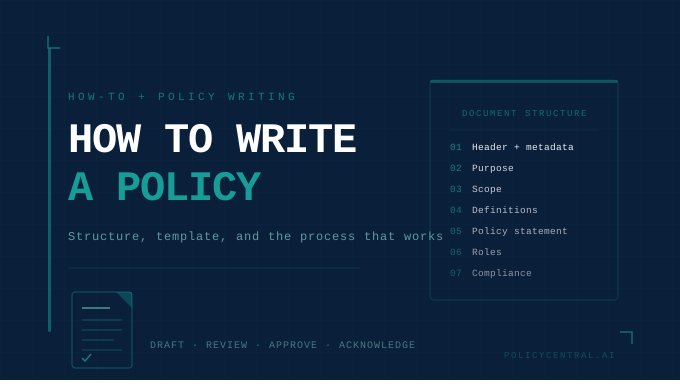
A policy document should follow a predictable structure. Predictability is a feature: when every policy in your library has the same shape, employees know where to look and reviewers know what to check. Use these sections as a template.
Header and metadata. Every policy needs a title, a document owner, a version number, an effective date, and a next-review date. This is not administrative decoration. Without it you cannot prove which version was in force on a given day, which is exactly the question an auditor or a court will ask.
Purpose. One short paragraph on why the policy exists and what risk it addresses. If you cannot state the purpose in two sentences, the policy is probably trying to do too much.
Scope. Who and what the policy covers, and any explicit exclusions. State whether it applies to full-time employees, contractors, interns, and vendors, and to which locations or business units.
Definitions. Define any term that a reasonable employee might interpret two ways. Ambiguity in a definition propagates into every clause that uses it.
Policy statement. The heart of the document: the actual rules, written as clear, testable requirements. Prefer “employees must” and “employees must not” over vague guidance. A requirement that cannot be tested cannot be enforced.
Roles and responsibilities. Who is accountable for what. Name roles, not individuals, so the policy survives staff changes.
Compliance and consequences. What happens when the policy is breached. A policy with no stated consequence is a suggestion.
Related documents and revision history. Links to the procedures, forms, and related policies, plus a dated log of every change. The revision history is your version-control backbone, and it is what turns a document into defensible evidence.
The process: from need to acknowledgment
A strong structure is necessary but not sufficient. How you take the document from idea to enforced rule matters just as much.
Policies, simplified with AI-powered automation
Book a 20-minute demo to see how PolicyCentral.ai streamlines policy creation, distribution, and compliance across your enterprise.
Book a DemoStart by confirming the need and assigning a single owner. A policy without a named owner drifts, because no one is responsible for keeping it current. Then draft in plain language, writing for the employee who has to follow the rule rather than the lawyer who has to defend it. Short sentences, concrete examples, and a readability pass do more for compliance than any amount of legal precision that no one reads.
Circulate the draft to the stakeholders it affects, including legal, the relevant business function, and, where relevant, employee representatives. Capture their input before approval, not after, because a policy that surprises the people it governs generates resistance rather than compliance.
Then route it for formal approval by whoever has the authority to issue it. Approval is the point at which a draft becomes a rule, so it must be recorded with a date and an approver. From there the document has to be distributed to exactly the right audience and acknowledged, and then scheduled for periodic review. The full arc, from draft to employee acknowledgment, is what we call the policy lifecycle, and treating it as a one-time publishing event rather than a lifecycle is where most policy programs quietly fail.
Common mistakes that turn a policy into a liability
A few errors show up again and again, and each one is avoidable.
The first is writing for the wrong audience. When a policy is written in dense regulatory language, employees click acknowledge without understanding what changed, and you end up with a signed record that documents receipt rather than comprehension. That distinction matters the moment a regulator tests whether your workforce actually understood an obligation.
The second is neglecting version control. When multiple versions of a policy circulate across email and shared drives, no one can say with certainty which one was in force when an incident occurred. Proper policy version control is not a nicety; it is what prevents a document dispute from becoming a legal exposure.
The third is treating publication as the finish line. Policies that are never reviewed drift out of alignment with the law, the business, and each other. A policy without a review date is a policy that will eventually be wrong.
The fourth, in the Indian context specifically, is ignoring language. A policy delivered only in English to a workforce that reads Hindi, Tamil, Bengali, or Marathi is a policy that a large part of the organization cannot genuinely follow. Multilingual delivery has moved from a courtesy to a compliance necessity.
Write for comprehension, then prove it
The goal of a policy is not a signed timestamp. It is an employee population that acts in line with the organization’s obligations. Everything in the writing process should serve that goal.
That means favoring plain language over legal density, structure over prose, and testable requirements over aspirational statements. It means distributing the finished policy only to the people it applies to, so the important communications are not lost in a stream of irrelevant ones. And it means capturing genuine engagement, through comprehension checks and an accessible way for employees to ask questions, rather than a bulk click-to-acknowledge.
A modern policy management platform supports each of these steps, from AI-assisted plain-language authoring to targeted distribution, multilingual delivery, and audit-ready acknowledgment records. If you want to see how PolicyCentral.ai handles the full journey from drafting to acknowledgment, request a demo and bring a policy you are struggling to make readable.
Frequently Asked Questions
What are the essential sections of a policy document?
A complete policy document includes a header with metadata (owner, version, effective and review dates), a purpose statement, a scope section, definitions, the policy statement itself, roles and responsibilities, compliance and consequences, and a list of related documents with a revision history. This structure makes policies predictable to read, review, and audit.
What is the difference between a policy and a procedure?
A policy states what the organization requires and why. A procedure describes the step-by-step method for carrying out that requirement. Keeping durable principles in the policy and changeable steps in a linked procedure means the policy does not need re-approval every time a form or tool changes.
How do I write a policy in plain language?
Write for the employee who has to follow the rule, not the lawyer who has to defend it. Use short sentences, concrete examples, and testable requirements phrased as “must” or “must not”. Run a readability pass before publishing, and use AI simplification tools to flag clauses likely to cause confusion.
How often should a policy be reviewed?
Every policy should carry a defined review date, typically annually, and should also be reviewed whenever a relevant law, regulation, or business practice changes. A policy without a review date drifts out of alignment and eventually becomes inaccurate or non-compliant.
Is writing the policy enough for compliance?
No. Writing is roughly a third of the work. The policy must also be distributed to the right audience, acknowledged with a defensible record, and kept current through scheduled review. A well-written policy that no one has read or acknowledged provides little protection in an audit.
Do policies need to be available in multiple languages in India?
Increasingly, yes. A policy delivered only in English to a workforce that reads regional languages cannot be genuinely followed by a large part of the organization. Delivering and tracking acknowledgment in the languages employees actually read has become a compliance necessity, not a courtesy.