It is a Tuesday morning in the HR shared inbox at Meridian Finance. The first mail of the day reads: “Hi team, quick question. If I take Friday and Monday off, does Saturday and Sunday also count as leave?”
The HR executive who opens it has answered this exact question eleven times this quarter. The answer sits in Section 6.4 of the Attendance and Leave Policy, a document that was emailed to every employee and uploaded to the intranet, and which the person now asking has almost certainly received twice.
She types out the sandwich leave rule one more time, hits send, and moves to the next mail. Which asks how full and final settlement is calculated.
This is not a story about employees being lazy. It is a story about how policy information is stored versus how policy questions are asked, and about the gap between the two that HR and compliance teams have quietly absorbed as unpaid, invisible work for decades.
The same questions, on loop
If you sit with any HR operations team for a week, a pattern emerges quickly. The questions are not random. They cluster, and they repeat. Look at what employees across India actually type into Google when their own organization’s answers are out of reach:
- Leave and attendance: what is sandwich leave, is weekend counted in sandwich leave, casual leave vs earned leave, comp off rules, leave encashment calculation, what is LOP in salary
- Exit and settlement: what is notice period buyout, how is full and final settlement calculated, how long does FnF take, relieving letter vs experience letter
- Money and claims: what expenses are reimbursable, petty cash limit, how to request salary advance, per diem meaning, travel entitlement by grade
- Performance: what is a PIP, is PIP a termination, what happens after a PIP, bell curve appraisal meaning
- Conduct and compliance: what is POSH policy, how to file a POSH complaint, show cause notice meaning, suspension vs termination
- Compensation: CTC vs in-hand salary, what is HRA, gratuity meaning, what is group mediclaim
Every one of these questions has an authoritative answer inside the asker’s own organization, in a leave policy, an exit policy, a reimbursement policy, a POSH policy. And yet the employee is asking a search engine, a colleague, or the HR inbox instead. Three things are worth noticing.
These are precise questions. The employee does not want the 19-page leave policy. They want to know whether the weekend between Friday and Monday counts. The document contains the answer; the document is not the answer.
Some of these questions carry real risk when answered informally. “Is PIP a termination?” and “how to file a POSH complaint” are not questions where a colleague’s half-remembered answer at the coffee machine is acceptable. An inaccurate informal answer to a POSH question is not an inconvenience. It is a compliance exposure.
The employee asking Google is telling you something. They looked for the answer somewhere other than your policy portal because the portal made them work too hard the last time. That is not an engagement problem. It is a findability problem.
Why policies are hard to ask questions of
Most organizations have done the responsible things. Policies are written, approved, published, distributed. And still the questions keep coming. Why?
Policies are written in policy language; questions are asked in human language. No leave policy contains the phrase “sandwich leave” as its heading. It says something like “intervening holidays and weekly offs between periods of leave shall be treated as leave.” The employee searching “sandwich leave” and the clause answering their question never find each other, because keyword search matches words, not meaning.
Policies are organized by document; questions cut across documents. “What do I get when I resign?” touches the exit policy, the leave encashment clause of the leave policy, and the gratuity section of the compensation policy. No single document answers it, so no document search can.
The answer lives in a clause, not a file. Even when an employee finds the right PDF, they now face 19 pages to locate one sentence. Most people give up somewhere around page four and email HR instead. Rationally, from their side, emailing HR is faster.
Every informal answer creates an unofficial version of the policy. When HR answers the same question eleven times in a quarter, in eleven slightly different email threads, the organization now has eleven slightly different phrasings of its sandwich leave rule in circulation. None of them is the policy; all of them are treated as the policy by their recipients. When the policy is later revised, none of those email threads updates itself.
What AI policy search actually does
This is the specific problem conversational AI over a policy corpus is built to solve. It is worth being precise about the mechanics, because “AI chatbot” has come to mean everything and nothing. An AI policy assistant like PolicyGPT does three things a document repository cannot.
Policies, simplified with AI-powered automation
Book a 20-minute demo to see how PolicyCentral.ai streamlines policy creation, distribution, and compliance across your enterprise.
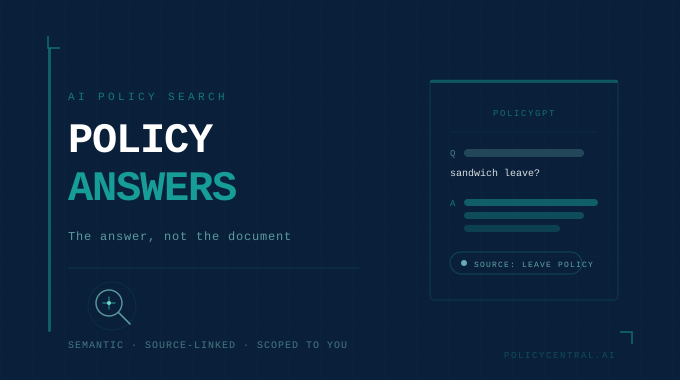
Book a DemoIt answers in the employee’s language, from the organization’s documents. The employee types “is weekend counted in sandwich leave,” the assistant understands the question semantically, finds the intervening-holidays clause in the leave policy, and returns the answer in plain language. The vocabulary mismatch that defeats keyword search stops mattering.
It answers from clauses, not files. Instead of returning “Attendance and Leave Policy.pdf (19 pages),” it returns the specific rule, with a link back to the source policy so the employee can verify the answer against the authoritative document. The answer and the audit trail travel together.
It answers only from what that employee is entitled to see. This is the part that matters most in a banking or financial-services context, so it deserves its own section.
The first question every infosec team asks
Introduce any generative AI feature to a bank’s information security team and the first question is predictable and correct: what stops it from answering out of scope? Two scenarios worry them. One, the assistant answers from the open internet, inventing or importing rules that are not the organization’s rules. Two, the assistant answers from documents the employee should not have access to, a branch executive asking about senior-management compensation bands and getting an answer.
PolicyGPT is scoped against both by design. It answers only from the policies that have been shared with that specific employee. The same profile-based targeting that governs which policies appear in an employee’s portal governs which policies the assistant can draw on. If a document was never distributed to you, the assistant cannot quote it to you. Access control is not a filter applied to the answer; it is the boundary of what the assistant can see in the first place.
And every question asked is itself a signal. Search and question analytics show publishers what employees are actually confused about, which is often the most honest feedback a policy team ever receives. If four hundred people ask about comp off in a month, the comp off clause needs rewriting, not four hundred more email replies.
What it does not do
Worth stating plainly, because the credibility of any AI feature rests on its boundaries being as clear as its capabilities. An AI policy assistant does not interpret law. It tells an employee what their organization’s POSH policy says about filing a complaint; it does not advise them on the POSH Act. It does not replace the policy document: every answer links back to the source, and the source remains authoritative. It does not answer beyond its corpus. A question with no answer in the distributed policies gets “this is not covered in your policies,” not an improvisation. And it does not replace HR judgment. The exception requests, the sensitive situations, the cases that genuinely need a human still go to a human, who now has time for them because the eleventh sandwich-leave email does not.
That last point is the honest version of the ROI argument. The value of AI policy search is not that HR answers fewer questions. It is that HR stops answering the same question, and the questions that do reach a human are the ones that deserve one.
Try it on real policies
Claims about AI search are cheap; the demo is not. We have loaded PolicyGPT with a full corpus of 65 real-world policies, spanning HR (leave and attendance, exit and final settlement, POSH, compensation, performance and PIP) as well as compliance, governance, and information security (KYC, anti-money laundering, code of conduct, data privacy, and cybersecurity), and put it on a public page where you can ask it anything those policies cover.
Before and after, in one table
| Document repository | AI policy search | |
|---|---|---|
| Employee asks | In HR’s inbox, or Google | In the assistant, in their own words |
| Answer comes from | Whoever replies first | The organization’s own policy clause |
| Consistency | Varies by responder and memory | Same source, every time |
| Verifiability | Email thread, no citation | Answer linked to the source policy |
| Access control | Whatever the responder remembers | Bounded by policy distribution rules |
| HR’s time goes to | Repeating known answers | Exceptions and judgment calls |
| Policy team learns | Nothing from the exchange | What employees are actually confused about |
An AI policy assistant is one capability inside a broader platform. It sits on top of the distribution, targeting, and acknowledgment machinery that puts the right policy in front of the right employee in the first place, delivered where needed in the languages employees actually read. If your HR and compliance teams are still absorbing the same questions on loop, the fix is not more replies. It is making the policies answerable. Request a demo and bring the question your inbox receives most.
Frequently Asked Questions
Does PolicyGPT answer from the internet or from our documents?
Only from your documents. The assistant is grounded in the policy corpus your publishers have distributed. Questions outside that corpus are declined rather than improvised, and every answer links back to the source policy for verification.
What stops an employee from seeing a policy they are not entitled to?
The assistant inherits the platform’s distribution rules. It can only draw on policies shared with that specific employee, using the same targeting by department, grade, location, or named individual that governs their portal. Scope is enforced at retrieval, not filtered afterwards.
Does this replace policy acknowledgment and attestation?
No, and it should not. Acknowledgment is a governance record: evidence that a policy reached an employee and was formally attested. The assistant handles the comprehension layer on top of that record. Distribution and attestation create the audit trail; the assistant makes the content usable day to day.
Can employees ask in languages other than English?
PolicyCentral.ai supports policy translation into ten Indian languages, and the assistant works alongside translated and audio versions of policies, so the comprehension layer extends to employees who are more comfortable reading or listening in Hindi, Tamil, Marathi, Bengali, and others.
What happens when a policy is updated?
The assistant answers from the current published version. This is one of its quiet advantages over informal email answers: an email explaining last year’s rule stays in the inbox forever, while the assistant’s answer updates the moment the policy does.