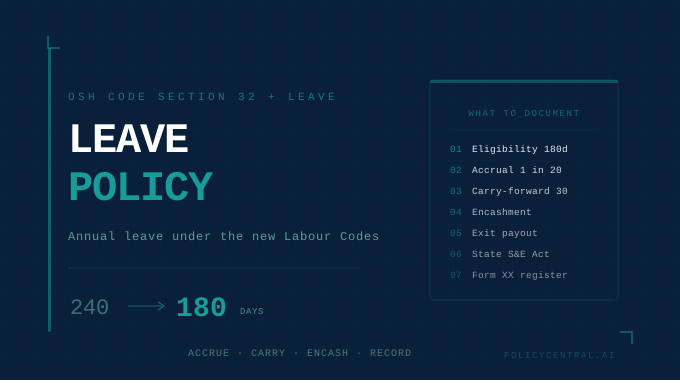
Most Indian leave policies were written around the Factories Act, 1948 and a state Shops and Establishments Act. Since 21 November 2025, the annual leave rules have a new home: Section 32 of the Occupational Safety, Health and Working Conditions Code, 2020. The threshold is lower, the carry-forward and encashment rules are explicit, and the Central Rules now require a leave register. If your policy still says “240 days”, it is out of date.
The Government made the four Labour Codes effective on 21 November 2025, as set out in the Ministry of Labour and Employment’s release. The text of the OSH Code sets the entitlement, and the Occupational Safety, Health and Working Conditions (Central) Rules, 2026, notified on 8 May 2026, add the record-keeping detail.
This guide covers what Section 32 requires, who it applies to, what it deliberately leaves to your state, and how to turn all of it into a leave policy employees can actually follow.
What the OSH Code says about annual leave
Section 32(1) gives every covered worker leave with wages in a calendar year, subject to the conditions below. This is the part of your policy that has changed the most.
- Eligibility: the worker must have worked 180 days or more in the calendar year. Under the Factories Act, 1948 the threshold was 240 days. The Ministry’s own FAQ on the Code confirms the 180-day test.
- Accrual: one day of leave for every 20 days of work. For an adolescent worker, and for a worker employed below ground in a mine, it is one day for every 15 days.
- What counts toward the 180 days: periods of layoff, maternity leave and annual leave already taken count toward the 180 days, but they do not themselves earn new leave.
- Holidays inside a leave period: holidays that fall between the days of leave taken are excluded from the leave, so they are not deducted from the balance.
- Mid-year joiners: a worker whose service starts after 1 January earns leave at the same rate if they work one-fourth of the days in the rest of that year.
Carry-forward, encashment and exit payouts
This is where leave policies most often go wrong, because the Code spells out three separate rules that older policies tend to blur together.
Carry-forward. Leave not taken in a year is added to the next year’s leave, but the total carried forward cannot exceed 30 days. There is one exception: if a worker applied for leave and the employer did not grant it, the refused leave can be carried forward without any limit. That makes refusals expensive to document badly. If your managers decline leave requests during a busy quarter, the unlimited carry-forward is the consequence.
Encashment. A worker is entitled to ask for encashment of leave at the end of the calendar year. Where the balance exceeds 30 days, the worker is entitled to encash the excess. Your policy should say how a request is made, by when, and how the payout is calculated.
Exit. When a worker is discharged, dismissed, resigns, retires or dies in service, they (or their heir or nominee) are entitled to wages in lieu of the leave they had earned, even if they had not yet worked long enough to be eligible to take it. Payment is due before the end of the second working day after a discharge, dismissal or resignation, and within two months of superannuation or death. Many full and final settlement timelines are slower than this.
Who is covered: the “worker” test
Section 32 applies to a “worker”. The Code defines that term broadly: any person employed to do manual, unskilled, skilled, technical, operational, clerical or supervisory work for hire or reward. That is wider than the shop floor, and it includes a lot of office staff.
Policies, simplified with AI-powered automation
Book a 20-minute demo to see how PolicyCentral.ai streamlines policy creation, distribution, and compliance across your enterprise.
Book a DemoThe definition then excludes some people. Anyone employed mainly in a managerial or administrative capacity is outside it, and so is a supervisor drawing wages above ₹18,000 a month (or another amount the Government notifies). Defense and police personnel are also excluded.
Two practical points follow. First, classification matters: a clerical or technical employee can be a “worker” for leave purposes, so a policy that treats all non-managers the same way needs a deliberate decision behind it. Second, most employers give one leave policy to everyone. That is allowed, since nothing stops you from offering more than the statutory minimum, but you should know where the legal floor applies so you never go below it for the people it covers. Your counsel should confirm how the definition applies to your roles.
What the Code does not cover: casual, sick and holidays
The OSH Code deals with annual leave with wages. It does not create a statutory casual leave or sick leave entitlement, and it does not set the list of paid festival and public holidays. In most establishments, those still come from the Shops and Establishments Act of the state where your office or outlet is located, and the rules differ from state to state.
We have deliberately not listed state-by-state numbers here, because they vary, they get amended, and the secondary guides that circulate online often disagree with each other. Before you finalize a policy:
- Read the current Shops and Establishments Act and rules for each state where you have employees, from the state labour department’s website.
- Record, for each state, the casual leave, sick leave, festival holiday and weekly off provisions, and the source you took them from.
- Check whether your state has notified its own rules under the OSH Code yet. Until it does, the older state rules and forms may continue to apply during the transition.
Maternity leave sits under a different law again. Our guide to the Maternity Benefit Act and what your policy must document covers it. Gratuity is covered in our gratuity guide.
Records: the leave register under the Central Rules
The Central Rules add a documentation duty that most leave policies do not mention. Rule 76 requires every employer to maintain, for each employee, a record of leave with wages in Form XX, electronically or otherwise.
- The employer must share the employee’s leave record with them, once in a calendar year, on demand.
- The register must be preserved for five years after the last entry, and not destroyed even then unless it has been properly transferred to a new register.
Form XX captures leave due, leave taken, leave refused, the date from which leave was due and the wages paid for leave. If your leave data lives in several spreadsheets or in each manager’s inbox, producing that record on demand is the real compliance challenge. Rule 64 of the same Rules also sets a maximum of 48 hours of work in a week, so working hours and leave records should be kept consistent.
What a good leave policy should contain
A leave policy is not a table of day counts. To work in practice, and to survive an inspection, it should cover:
- Scope and definitions: who the policy covers, which employees are statutory “workers”, and which state Act applies to each location.
- Each leave type: annual or earned, casual, sick, maternity and paternity, compensatory off, loss of pay and any leave you offer beyond the law, with entitlement, accrual and eligibility for each.
- Accrual rules: the 180-day test, the one-in-20 rate, treatment of joiners mid-year, and what counts toward eligibility.
- Applying and approving: how to apply, notice periods, who approves, how long they have to respond, and how refusals are recorded.
- Carry-forward and encashment: the 30-day cap, the unlimited carry-forward for refused leave, how and when to request encashment.
- Exit and settlement: the payout of earned leave and the deadline for it.
- Holidays and weekly offs: the holiday list by location and how holidays interact with leave.
- Records and review: where the leave register is kept, who owns it, and when the policy is reviewed.
If you are starting from scratch, our guide on how to write a policy document gives you the structure, and the list of HR policies every Indian company should have shows where leave sits among the others.
Five leave policy mistakes we see most often
- Still using 240 days. Policies copied from older Factories Act or state templates carry the old threshold.
- Capping carry-forward for everyone. A 30-day cap is the rule, but leave that was applied for and refused is outside it.
- No exit rule. The policy covers encashment during employment but says nothing about the second working day payout.
- One policy for every state. A single national document that ignores state Shops and Establishments Acts will be wrong somewhere.
- No record employees can see. Leave balances live in a payroll tool, but nothing can produce the Form XX record on request.
The common thread is that the rules changed, but the policy document and the people who apply it did not. Our article on how the Labour Codes force a rewrite of HR policies covers the wider picture.
Getting the new leave policy to the people who apply it
Updating the document is half the job. Managers approve and refuse leave, payroll calculates the balances, and employees need to know their entitlement. Each group needs the right version, in a language they read, and you need proof they received it. See how that works in practice in our guides on policy lifecycle management, new joiner policy acknowledgment and acknowledgment tracking.
How PolicyCentral.ai helps
PolicyCentral.ai manages the full lifecycle of your leave policy. It routes the draft through review and approval, publishes the approved version to the right employees by location or entity, and delivers it in ten Indian languages. It records who acknowledged which version and when, reminds owners when a review is due, and lets employees ask plain-language questions such as “how many days can I carry forward?” and get an answer grounded in your current policy.
If you are rewriting your leave policy for the Labour Codes, request a demo and bring the current document. It is a quick way to see how version control, state-wise distribution and acknowledgment fit together. This guide is for general information and is not legal advice.
Frequently Asked Questions
How many days must an employee work to be eligible for annual leave in India now?
Under Section 32 of the OSH Code, 2020, a worker must have worked 180 days or more in a calendar year to be entitled to annual leave with wages. Under the Factories Act, 1948 the threshold was 240 days. The Labour Codes took effect on 21 November 2025.
How much annual leave does a worker earn under the OSH Code?
One day of leave for every 20 days worked. For adolescent workers, and workers employed below ground in a mine, it is one day for every 15 days worked.
How many days of annual leave can be carried forward?
A maximum of 30 days can be carried forward to the next calendar year. The exception is leave a worker applied for but the employer did not grant, which can be carried forward without any limit.
Can employees encash unused leave?
Yes. A worker can ask for encashment of leave at the end of the calendar year, and where the balance is more than 30 days, the worker is entitled to encash the excess.
What happens to earned leave when an employee resigns?
The worker is entitled to wages in lieu of the leave they had earned, even if they had not worked long enough to be eligible to take it. Payment is due before the end of the second working day after the discharge, dismissal or resignation. On superannuation or death, it is due within two months.
Does the OSH Code cover sick leave and casual leave?
No. The Code covers annual leave with wages. Casual leave, sick leave and festival holidays are generally set by the Shops and Establishments Act of the state where the establishment is located, so check the Act and rules for each state in which you employ people.
What leave records must employers keep under the Central Rules?
Rule 76 of the OSH Central Rules, 2026 requires a record of leave with wages in Form XX for every employee, electronically or otherwise. The employer must share the record with the employee once a year on demand, and preserve the register for five years after the last entry.
Can PolicyCentral.ai help us roll out an updated leave policy?
Yes. PolicyCentral.ai handles approval, version control, distribution by location, delivery in ten Indian languages, acknowledgment tracking with a tamper-evident audit trail, and an AI assistant that answers employee questions from the current policy text.